
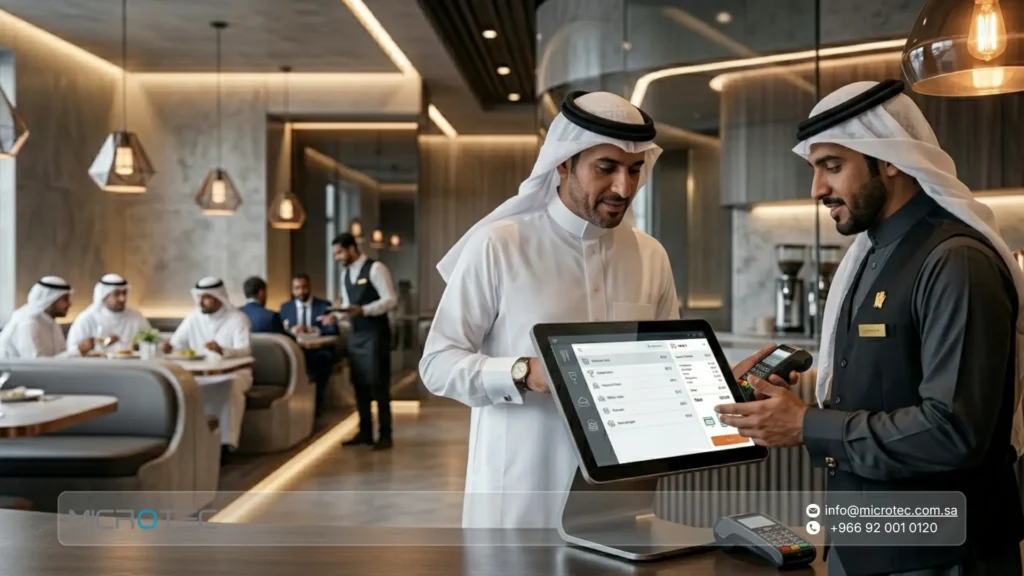
Restaurant and café owners in Saudi Arabia face daily challenges that go far beyond simply serving good food. They need to maintain fast service, accurate inventory management, and compliance with tax regulations. Therefore, choosing a restaurant POS system is no longer an optional step; it is a strategic decision that can determine a business’s ability to grow and remain competitive.
In this article, we review the most important criteria for choosing a POS system for restaurants that supports operational efficiency and seamless branch integration, while highlighting how an integrated solution such as Microtec’s O-RED system can be the right choice for restaurants in Saudi Arabia.
7 Essential Criteria for Choosing a Restaurant POS System That Meets All Your Needs
Choosing the right restaurant POS system is a strategic investment that directly affects the efficiency of your daily operations and the level of customer satisfaction. To make the right decision for your business in the Saudi market, the following criteria and essential features should be considered when evaluating any POS solution to support operational excellence and sustainable growth.
1. Fast and Seamless Order Taking and Kitchen Routing
In busy restaurant environments, delays in transferring orders from the table to the kitchen are among the biggest operational challenges. Traditional order cycles that rely on pen and paper or basic systems often result in ingredient errors, preparation delays, and confusion between orders.
Modern solutions change this process completely. When you rely on an advanced restaurant POS system, you can achieve:
- Overcoming operational challenges: Modern systems eliminate errors associated with handwritten orders and preparation delays, helping ensure order accuracy and preventing confusion between dine-in and takeaway orders.
- Flexible management and automated routing: These systems provide interfaces for table management, including merging, transferring, and opening tables, while automatically routing orders to the kitchen as soon as they are entered.
- Digital kitchen displays: Kitchen display screens replace paper printers that may be vulnerable to damage, helping reduce bottlenecks and improve table turnover rates.
To achieve this level of efficiency, Microtec’s O-RED restaurant system provides an integrated solution for organizing and managing restaurants and cafés. It combines dine-in, takeaway, and delivery orders within a unified operating interface that helps maintain a smooth workflow.
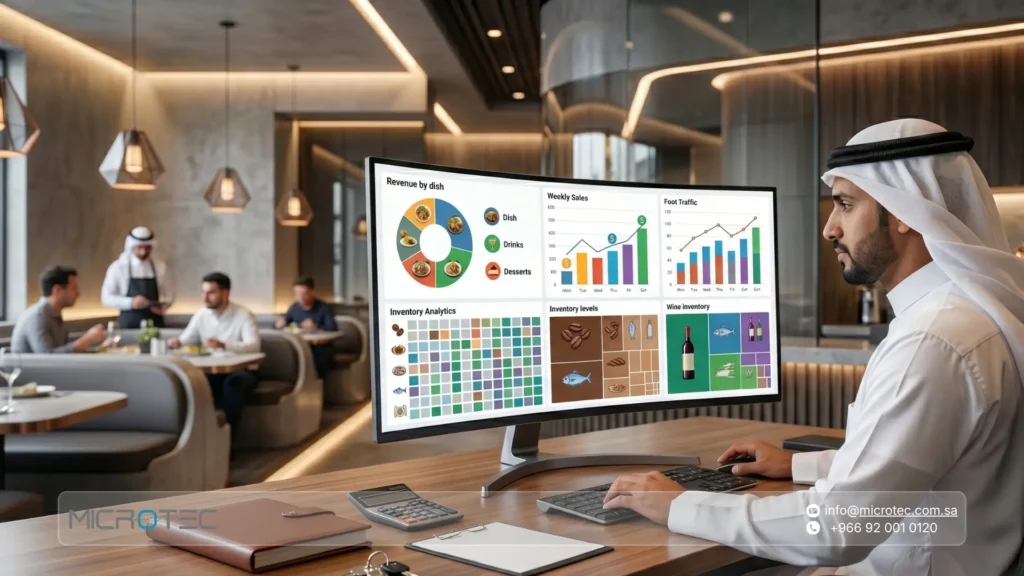
2. Real-Time Inventory Tracking to Control Food Costs and Reduce Waste
Profitability in the food and beverage industry depends heavily on accurate control over ingredient costs. Many businesses lose a significant portion of their profits because of hidden waste or theft that is difficult to track manually.
The solution is to connect POS sales directly with warehouse management through a restaurant POS system that supports recipe management. This feature links every meal sold to its raw ingredients, allowing the required quantities to be deducted from inventory immediately after the sale is completed.
In addition, restaurant point of sale software can provide intelligent low-stock alerts to help prevent unexpected shortages.
How Recipe Deduction Works in a Real-Time System
| Item Sold (Beef Burger Meal) | Automatic Deduction from Central Warehouse | Operational and Financial Impact |
|---|---|---|
| Burger bun | 1 piece | Updates the available bun quantity and cost |
| Beef patty | 150 grams | Accurately calculates the cost of meat sold |
| Cheddar cheese | 1 slice | Generates an alert when cheese reaches the minimum stock level |
| Special sauce | 20 ml | Helps reduce waste of liquid ingredients |
To implement this feature effectively, the point-of-sale solution should be supported by an integrated cloud based POS system for management and inventory, ensuring a continuous and reliable flow of data.
Contact the Microtec team and book a live demonstration of O-RED to see how the system connects your sales with your inventory in real time.
Read Also: The Accounting Chart of Accounts: Strategic Guide for Digital Transformation
3. Offline Operation to Ensure Business Continuity Without Disruption
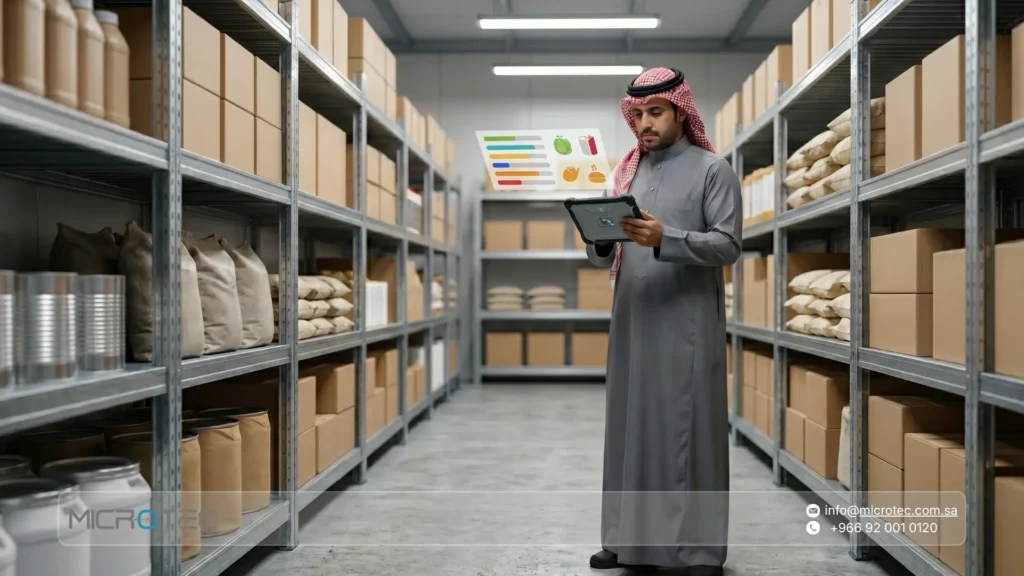
Modern POS systems provide an Offline Mode that can be relied on for:
- Handling internet outages: Choosing an offline POS system protects your restaurant from operational interruptions and lost sales when the internet goes down during peak hours.
- Maintaining essential operations: The system allows employees to continue opening tables, recording dine-in orders, and issuing invoices locally on the device without requiring a direct connection to the server.
- Automatic and secure synchronization: Once the internet connection is restored, the system automatically uploads all stored transactions to the cloud servers through Auto-Sync, maintaining data accuracy without duplication or conflicts.
Important note: Offline operation is generally limited to cash transactions and internal restaurant orders. Electronic payments through mada and credit cards require an active network connection for immediate bank authorization.
4. Financial Flexibility Through mada and Digital Payment Support
Consumer behavior in Saudi Arabia has undergone a major shift toward digital payments. As a result, relying on a restaurant POS system that supports mada has become an essential requirement for faster service.
One of the most important features is direct integration between the POS system software and the bank payment terminal. This connection prevents cashiers from manually entering transaction amounts into the payment device, eliminating human input errors and significantly simplifying account reconciliation while reducing cash register discrepancies at the end of each shift.
The system also offers greater flexibility when splitting bills between customers and issuing separate tax-compliant receipts.
5. Interactive Customer Displays That Allow Customers to Track Their Orders
Using a restaurant POS system with a customer-facing display provides several advantages, including:
- Greater transparency: Customers can view order details, prices, and VAT amounts clearly and in real time.
- Fewer operational errors: Customers can review their selections before the final invoice is issued, helping reduce order preparation errors.
- Greater marketing value: The display can be used as a promotional tool to showcase high-quality images of new meals and current offers.
- Increased sales opportunities: The screen can also encourage customers to join a loyalty program, potentially increasing the overall basket size.
Learn more: What is Meant by POS in a Bank Statement? A Merchant’s Guide
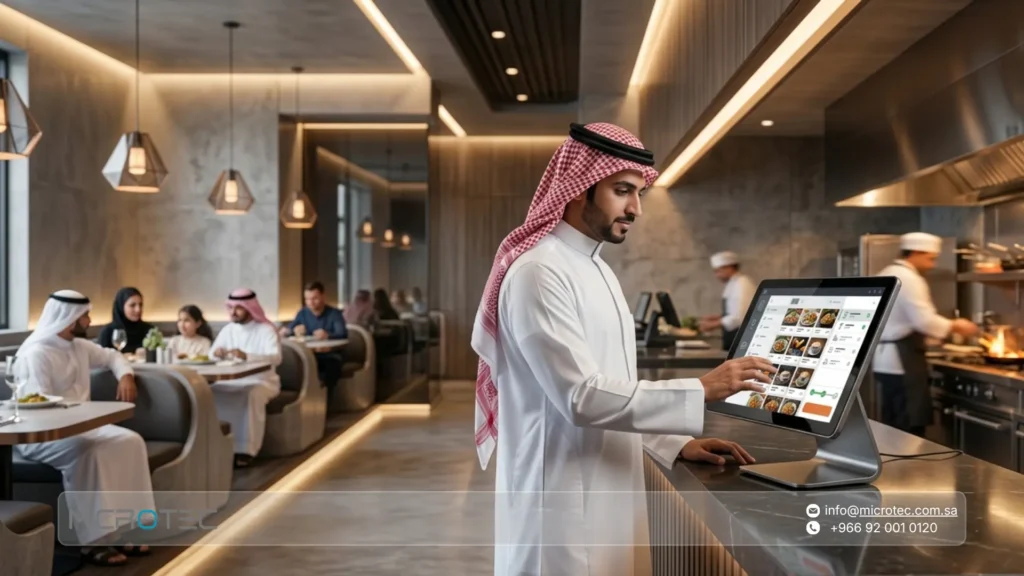
6. Tax Compliance and Readiness for ZATCA Phase Two Requirements in Saudi Arabia
With continuously evolving regulatory requirements, it is important to choose a restaurant POS system capable of meeting the requirements of the Zakat, Tax and Customs Authority (ZATCA), particularly Phase Two, known as the Integration Phase.
Failure to comply with these requirements may expose businesses to financial penalties and create significant difficulties when preparing tax returns. A compliant system should provide:
- Simplified tax invoices in XML or PDF/A-3 format.
- Generation of a cryptographically secured QR Code containing the mandatory invoice information.
- Automatic and secure integration with the Fatoora platform for data exchange.
Legal note: Tax requirements and legal details should always be reviewed through the official Zakat, Tax and Customs Authority channels or with a licensed professional accountant. Microtec provides the technical support required to implement these requirements efficiently within its systems.
7. Integration Between the POS System and a Complete ERP System
When managing a growing restaurant or a chain of branches, relying on isolated systems can create serious operational gaps. The POS system records sales independently, accounting is handled manually, and warehouses maintain separate inventory records. This often results in conflicting figures and slower decision-making.
The solution is to choose a POS system restaurant solution that can integrate with a comprehensive Enterprise Resource Planning (ERP) system.
This allows sales journal entries to be automatically transferred to the general ledger, bank accounts to be reconciled, and assets and expenses to be updated. The system can also support human resources management by linking employee attendance and working hours across branches with centralized management.
Standalone Systems vs. Integrated ERP Systems
| Criteria | Standalone POS | Integrated Systems (O-RED + Microtec ERP) |
|---|---|---|
| Financial data entry | Manual, repetitive, and vulnerable to human error | Automatic and immediate after closing the cashier shift |
| Branch inventory management | Separate inventory counts and difficulty transferring stock | Unified warehouses with real-time tracking of stock transfer requests |
| Reporting | Requires manually collecting data from each branch | Centralized dashboard displaying consolidated performance instantly |
| Employee management | Separate attendance systems and complex payroll processes | Direct integration between working hours and centralized payroll |
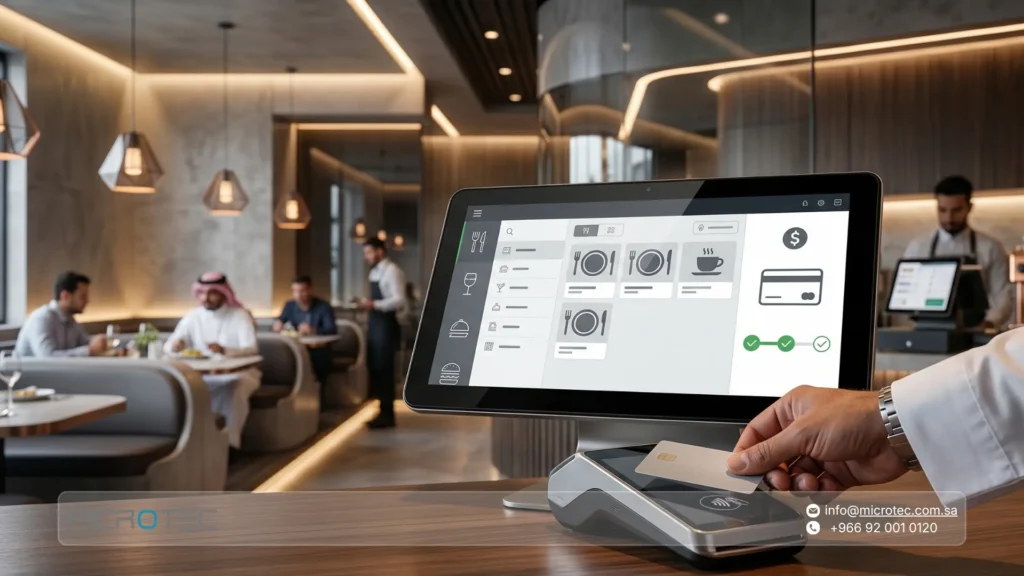
Strategic Criteria for Choosing the Right Restaurant POS System in Saudi Arabia
Before signing any contract or subscription, decision-makers should rely on clear evaluation criteria that ensure a genuine return on investment from a restaurant POS system:
- Technical support response time: Make sure local support is available and understands the Saudi market and the importance of resolving problems quickly during peak operating hours.
- System stability: The solution should work smoothly in both online POS system and offline environments.
- Flexibility and ease of use: A simple user interface can significantly reduce the time required to train new employees.
- Comprehensive integration: The system should support future expansion and integration with accounting and ERP solutions.
- Tax compliance: The solution should be fully prepared for integration with ZATCA requirements and banking systems such as mada.
O-RED, supported by Microtec’s technology infrastructure, offers an advanced solution that combines the flexibility of a POS system for restaurants with the capabilities of centralized business management, helping restaurants expand through a stable and reliable operating environment.
Contact us a Microtec today to identify the right solution for your business and book a customized demonstration for your restaurant or café in Saudi Arabia.
Frequently Asked Questions About Choosing a Restaurant POS System in Saudi Arabia
1- Can a Restaurant POS System Continue Working Efficiently If the Internet Suddenly Goes Down?
Yes. Modern systems such as O-RED support Offline Mode. This allows restaurants to continue opening tables, taking orders, and printing invoices locally while securely storing the transaction data.
Once the internet connection is restored, the pos system offline functionality automatically synchronizes the stored data with the cloud-based management platform without requiring manual intervention.
2- What Are ZATCA’s Phase Two Requirements for Restaurant POS Systems?
During the Integration Phase, ZATCA requires:
- Direct integration: The POS system must be technically connected to ZATCA’s Fatoora platform.
- Invoice formatting: Electronic invoices must be generated in XML format or PDF/A-3 format with an embedded XML file.
- QR Code: The system must generate an encrypted QR Code that complies with the technical standards established by the authority to maintain compliance and avoid potential penalties.
3- How Can a Restaurant POS System Reduce Food Costs and Minimize Waste?
- Automated inventory integration: Sales transactions are directly connected to the recipe management functionality within the system.
- Immediate ingredient deduction: Whenever an item is sold, the ingredients required to prepare that dish are automatically deducted from restaurant inventory in real time.
- Accurate cost calculations: The system accurately calculates the Cost of Goods Sold (COGS).
- Waste control: Actual inventory shortages can be identified by comparing the theoretical consumption recorded by the system with the physical stock remaining in the warehouse.
4- Is It Better to Integrate a Restaurant POS System with an ERP System, or Is Standalone Sales Software Enough?
For a small restaurant operating a single branch, standalone sales software may temporarily be sufficient.
However, for business growth and multi-branch restaurant chains, integrating the cashier system with an ERP platform becomes essential. It enables automatic posting of financial entries, centralized purchasing management, and coordination between human resources and warehouse operations through one integrated dashboard, reducing data conflicts and manual errors.
Related Articles
 FMCG Distribution Management System for Food, Beverage & Pharma Distributors
 Best POS System for Restaurant in Saudi Arabia: Comparison and Selection Criteria
 Best Café POS System in Saudi Arabia: Complete Guide for Coffee Shops
 Retail POS System Guide: Best Point of Sale Software for Stores in Saudi Arabia