
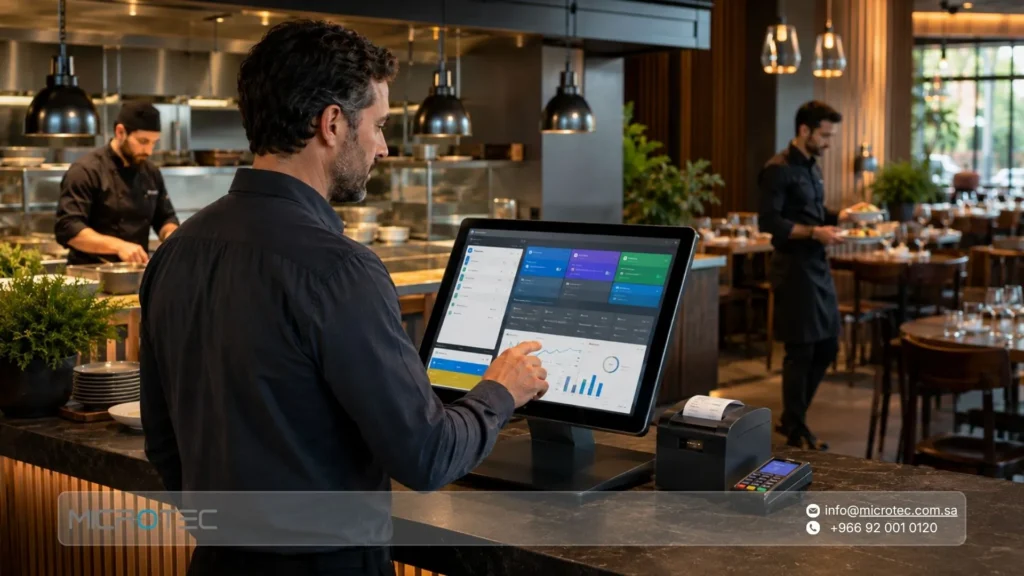
A comprehensive restaurant management system goes far beyond simply printing a receipt. At the end of each day, restaurant owners in Saudi Arabia need clear sales figures, accurate inventory balances, ZATCA-compliant invoices, and unified orders from dine-in and delivery channels.
This article explains how restaurant management software can transform a point-of-sale system into a daily control center by automatically deducting ingredients, monitoring performance, reviewing reports, and connecting online orders with accounting operations. You will also learn how to compare restaurant POS system costs based on scalability, technical support, and ease of integration before making a purchasing decision in 2026.
Key Takeaways from This Article:
- 4–10% of the food purchased by restaurants does not reach customers, making POS and inventory integration essential for protecting margins and reducing waste.
- Wholesale food prices in April 2026 were approximately 35% higher than in February 2020, which means purchasing and storage errors have become more costly.
- In Saudi Arabia, e-invoicing operates in two phases, with the Integration Phase beginning on January 1, 2023.
- Choose your POS system based on inventory management, invoicing, reporting, scalability, and technical support — not price alone.
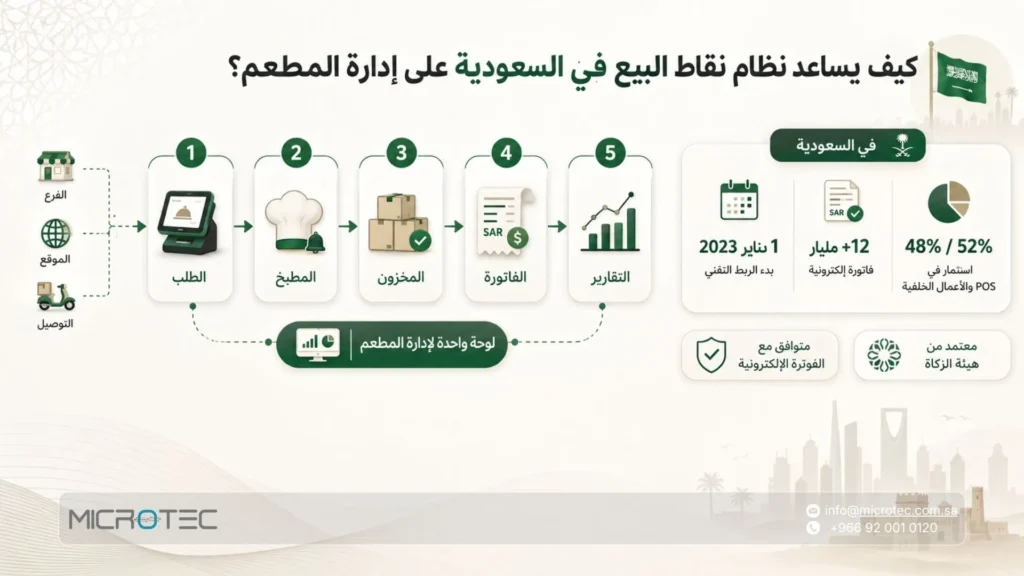
How Does a POS System Help Manage a Restaurant in Saudi Arabia from Order to Invoice?
Choosing a POS system for a restaurant in Saudi Arabia starts with a practical question: Do you only need a cashier system that records sales, or do you need a system that connects orders with the kitchen, inventory, invoicing, delivery, and reporting?
This question matters because restaurant operations are no longer limited to taking orders and processing payments. Customers may place orders at the branch, through the restaurant website, or via a delivery application, while the restaurant owner needs to see all of these transactions from one centralized interface.
This is why many restaurant owners look for the best restaurant management software or a simple restaurant POS system that provides essential functionality without adding unnecessary complexity to employees’ daily tasks.
In Saudi Arabia specifically, system selection becomes even more important because of e-invoicing requirements and technical integration with financial systems. The Integration Phase began on January 1, 2023, in waves, while the number of electronic invoices processed through the Fatoora platform has exceeded 12 billion. This demonstrates why selecting a ZATCA-compliant POS system is no longer a secondary consideration when implementing restaurant management technology.
Recent restaurant industry data also shows that 48% of operators consider POS systems a technology investment priority, while 52% plan to invest in back-office technologies such as accounting, compliance, and operations.
For this reason, you should not compare restaurant POS systems based solely on their monthly subscription fees. Instead, evaluate the price against the time the system saves, the errors it helps reduce, and the visibility it provides into orders, inventory, and sales.
If your restaurant receives orders through multiple channels, you may need a POS system integrated with online ordering. If you operate internal or third-party delivery, delivery management within the POS system can help you track each order until it reaches the customer.
For restaurants with multiple branches or more complex financial operations, integrating the POS system with SAP or another ERP platform should be considered early so that expansion does not create additional administrative burdens.
The following table summarizes the key differences restaurant owners should consider:
| Comparison Point | Traditional Cashier | Restaurant POS System |
|---|---|---|
| Orders | Records the sale amount | Connects orders to tables, the kitchen, or online ordering |
| Inventory | Requires frequent manual stock counts | Deducts ingredients or items after each sale when inventory management is enabled |
| Invoicing | Relies on limited settings | Supports e-invoicing requirements when using a compliant system |
| Delivery | Requires external tracking | Connects orders with delivery status and delivery drivers |
| Reporting | Displays total sales | Shows best-selling products, peak periods, branch performance, and order sources |
If you are comparing different restaurant POS systems in Saudi Arabia, start by identifying your order channels, number of branches, inventory management method, and invoicing requirements.
You can then contact our Microtec team to identify a system that suits your restaurant operations in Saudi Arabia without paying for unnecessary functionality.
Read Also: Restaurant POS System Features: What to Look For Before You Buy
What Are the Essential Features of Restaurant Management Software for a Small Restaurant?
When managing a small restaurant, you need more than a sales screen. You need restaurant management software that helps you control orders, monitor inventory, issue invoices, and identify the products generating the highest sales.
The first advantage is faster order entry, followed by immediate transmission to the kitchen or preparation station. The system then helps reduce communication errors between cashiers, employees, and customers.
For this reason, you should not evaluate the cost of a restaurant POS system based only on the subscription price. Instead, compare the price with the operational clarity and control the system provides.
In 2025, 52% of restaurant operators planned to invest in POS systems, while 47% planned to invest in inventory management software. These figures explain why restaurant inventory management software has become an increasingly important part of restaurant operations, particularly for businesses dealing with fast-moving products or ingredients affected by daily waste.
When every sale is directly connected to inventory, purchasing decisions can be based on actual stock movement instead of estimates made at the end of the day.
Before choosing a system, connect each feature to your restaurant’s daily operational requirements:
| Feature | How Does It Help a Small Restaurant? | When Do You Need It Most? |
|---|---|---|
| Fast order entry | Reduces ordering errors and waiting times | During peak periods and in restaurants with frequent orders |
| Inventory management | Connects sales with available quantities | When managing many ingredients or significant daily waste |
| E-invoicing | Helps maintain compliance with invoicing requirements in Saudi Arabia | When looking for a ZATCA-compliant POS system |
| Online ordering | Consolidates website and digital-channel orders into one workflow | When receiving orders outside the physical branch |
| Delivery management | Tracks an order until it reaches the customer | When operating internal or third-party delivery |
| Daily reports | Identifies best-selling items and peak operating periods | When making purchasing, pricing, or employee scheduling decisions |
| Accounting integration | Reduces manual data entry between sales and accounting | When integrating POS with SAP or another ERP system |
If you are looking for restaurant management software in Saudi Arabia for a small restaurant, start with your daily operational checklist: orders, inventory, invoices, delivery, and accounting integration. The Microtec team can then help you choose a system that fits your restaurant in Saudi Arabia without unnecessary features that increase costs.
How Does a POS System with Inventory Management Help Control Restaurant Ingredients?
A POS system with inventory management helps you understand what leaves your kitchen after every order, rather than waiting until the end of the day.
When the cashier sells a meal, the system automatically deducts its ingredients from inventory, such as bread, meat, sauce, packaging, or any other item linked to the product.
This feature gives the restaurant owner a clearer view of ingredient movement. You can identify which item runs out quickly, which product causes waste, and how much stock you need before placing your next purchase order.
This is particularly important for small restaurants that need to control costs without increasing staffing levels or making operations more complicated.
If your restaurant is losing ingredients without a clear explanation, using restaurant inventory management software can help connect every sale with the quantity actually consumed.
You may need to connect your POS system with inventory management if you experience one or more of the following situations:
- Some ingredients run out before the end of the day.
- Manual inventory counts do not match recorded sales.
- Certain ingredients are being wasted without a clear reason.
- You have difficulty determining the right quantities to purchase.
- You sell products that depend on shared ingredients, such as burgers, pizza, coffee, or fast-food meals.
Want to connect your cashier system with your restaurant inventory? The Microtec team can help you choose the right restaurant management software in Saudi Arabia for your operating model, whether you manage a single branch or are planning to expand.
Read Also: The Accounting Chart of Accounts: Strategic Guide for Digital Transformation
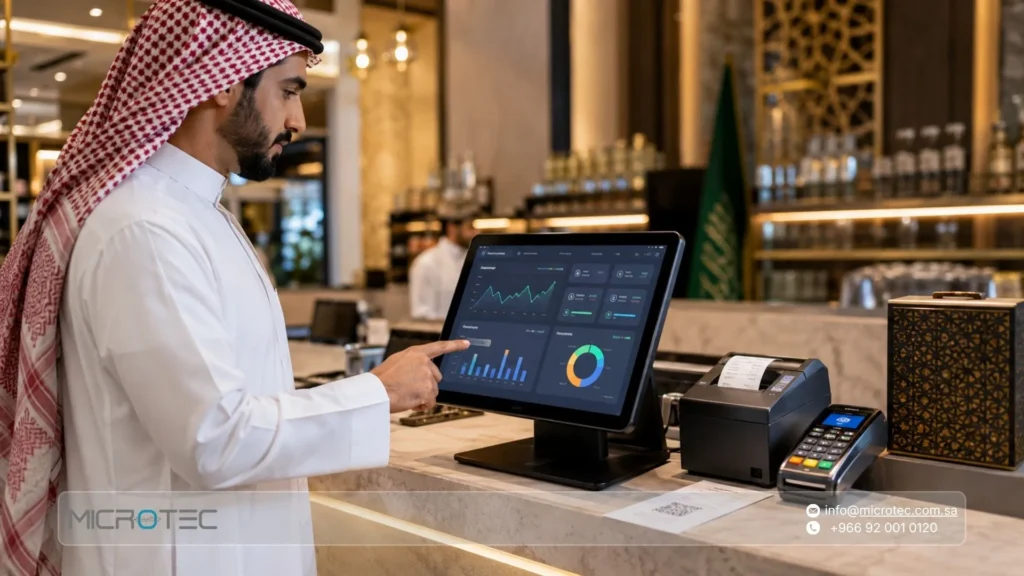
How Do You Choose a POS System That Complies with ZATCA Requirements in Saudi Arabia?
Choosing a POS system that complies with ZATCA requirements starts with verifying compliance rather than evaluating the appearance of the cashier interface.
In Saudi Arabia, the system should support electronic invoice issuance, invoice data storage, and integration with Phase Two requirements once your establishment is included in the relevant integration waves.
Phase Two began on January 1, 2023, and the number of electronic invoices processed through the Fatoora platform has exceeded 12 billion invoices. This figure demonstrates the scale of reliance on compliant systems within the Saudi market.
Therefore, when comparing restaurant POS system prices, ask about compliance before considering additional features.
A simple POS system may be sufficient for a single branch, but a restaurant that receives orders from the branch, website, and delivery channels needs a system that connects invoices with sales and reporting without requiring excessive manual data entry.
Before choosing a system, review the following points:
| What You Need to Check | Why Does It Matter to Your Restaurant? | Direct Question to Ask the Provider |
|---|---|---|
| E-invoicing | Ensures that every sale generates an invoice with the correct data | Does the system support invoicing requirements in Saudi Arabia? |
| Phase Two | Some establishments are required to integrate with ZATCA systems according to the implementation waves | Is the system ready for integration when my establishment is included? |
| Invoice storage | Makes it easier to retrieve invoices for review or reconciliation | Where are invoices stored, and who has access to them? |
| Inventory management | Connects sales with ingredient consumption | Does the system deduct ingredients after each order? |
| Online orders | Consolidates branch, website, and delivery orders | Does the system support online ordering integration? |
| Reports | Provides faster visibility into sales, taxes, and products | What reports can I review on a daily basis? |
Before adopting any restaurant management software in Saudi Arabia, ask the provider to explain the complete invoice flow from the moment of sale through storage and integration. The Microtec team can help you choose a solution that fits your restaurant requirements in Saudi Arabia and connects inventory, orders, and reporting according to your operational scale.
Read Also: What is Meant by POS in a Bank Statement? A Merchant’s Guide
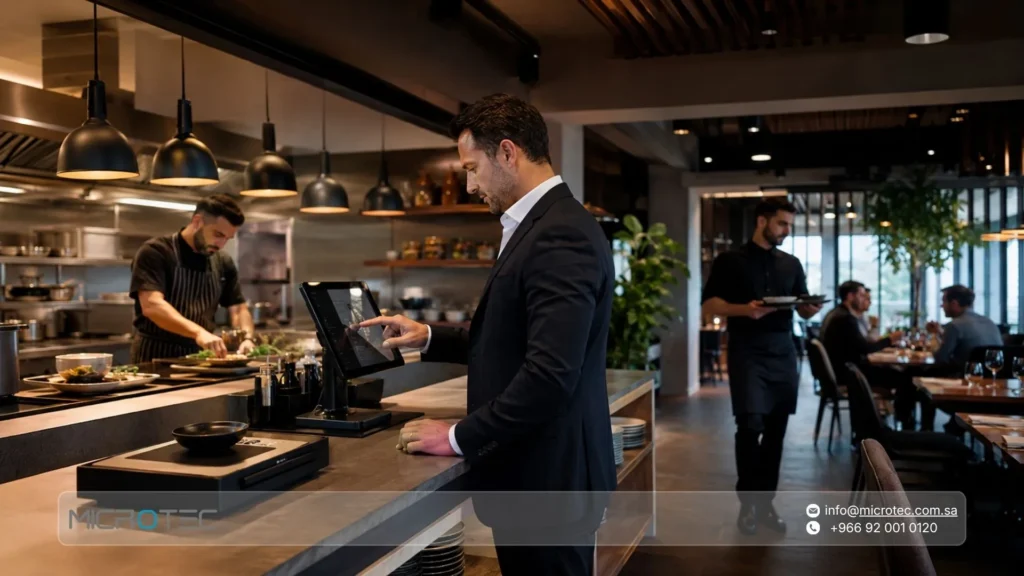
How Can You Make a Restaurant POS Interface Faster for Employees and Clearer for Restaurant Owners?
Successful restaurant POS software design starts with a screen that employees can understand within minutes, not an interface crowded with buttons.
When a customer reaches the cashier, the employee needs to select the item, modify the order, send the ticket to the kitchen, issue the invoice, and update inventory without moving through too many screens.
This detail directly affects daily operations.
In 2025, 52% of restaurant operators planned to invest in POS systems, while 55% focused on technologies that improve service efficiency and 52% on technologies that improve kitchen efficiency.
These figures explain why the system interface should support employees during busy periods rather than adding extra steps.
For this reason, when choosing restaurant management software, test the full order journey in front of you, from adding the meal until the invoice is closed.
If employees require lengthy training to complete a simple order, the interface may slow service during peak periods. However, if the screen is clear, a simple restaurant POS system can become an everyday tool for reducing errors and speeding up orders.
What should you see in the cashier interface?
- Clear buttons for the most frequently ordered items.
- Fast modification of add-ons, removals, and notes.
- Direct order transmission to the kitchen or preparation station.
- Connection between the order, invoice, and inventory within the same workflow.
- An interface suitable for dine-in, takeaway, and delivery orders.
- Daily reports that are easy for restaurant owners to read.
To evaluate the interface without unnecessary complexity, use the following table before purchasing the system:
| Interface Element | Impact Inside the Restaurant | Practical Question Before Choosing |
|---|---|---|
| Item arrangement | Reduces search time during peak hours | Can employees quickly reach the most frequently ordered meal? |
| Order modification | Reduces errors in add-ons and special notes | Can employees modify the order from a single screen? |
| Kitchen integration | Speeds up preparation and reduces unnecessary communication | Does the ticket reach the kitchen immediately after the order is saved? |
| Inventory integration | Reveals ingredient consumption after each sale | Does the system automatically deduct ingredients? |
| Online ordering | Consolidates website and digital-channel orders | Does the system support online ordering integration? |
| Delivery | Organizes order status after it leaves the restaurant | Does the POS system support delivery management? |
Before adopting any restaurant management software in Saudi Arabia, request a practical demonstration using an actual order from your restaurant menu. The Microtec team can help you choose an interface that suits your employees and connects the cashier with the kitchen, inventory, invoices, and delivery operations in Saudi Arabia.
How Does a POS System Connect Branch, Website, and Delivery Orders in One Workflow?
When your restaurant receives orders from the branch, website, delivery applications, or a QR code, fragmentation becomes a problem: one order arrives late, another invoice requires manual entry, and inventory does not reflect actual sales.
This is where a POS system with online ordering integration becomes valuable because it brings all orders into one screen that both the cashier and kitchen can use without copying information or relying on external tracking.
Recent data indicates that 47% of consumers order takeaway meals at least once a week, while 37% order delivery once a week.
This explains why restaurants need to connect ordering channels with their restaurant management software instead of distributing orders across separate devices and accounts.
Once the channels are connected, operations become clearer.
The order enters the system, reaches the kitchen, generates a receipt or invoice, and inventory is then reduced according to the items sold.
If you provide delivery services, POS delivery management can help you track the order from preparation until it leaves the restaurant and reaches the customer.
Which channels should you connect?
| Order Channel | Problem Without Integration | What Does the POS System Provide? |
|---|---|---|
| Branch orders | Fast entry with a risk of errors during busy periods | Sends the order to the kitchen and connects it directly to the invoice |
| Restaurant website | Orders remain outside the cashier interface | Consolidates digital orders into the same sales workflow |
| Delivery applications | Manual tracking across multiple devices | Displays order status and reduces lost details |
| In-restaurant QR | Orders require employee review | Sends the order to the preparation station without unnecessary steps |
| Inventory | Inaccurate quantities after sales | Deducts items or ingredients associated with each order |
| Reports | Figures are scattered across different channels | Displays sales by channel, branch, and product |
Before choosing restaurant management software in Saudi Arabia, map your restaurant’s order journey: Where does the order come from? Who reviews it? How does it reach the kitchen? When is inventory reduced? Our Microtec team can then help you choose a system that connects online orders, delivery, invoicing, and inventory within one workflow that suits your restaurant operations.
Ultimately, choosing integrated restaurant management software for a small restaurant is a strategic decision that can put your business on a path toward growth and development.
By connecting sales, inventory, and tax compliance within one system, you reduce the burden of managing fragmented data and can focus more on improving the quality of your services.
Take the next step toward digitizing your restaurant and choose a technology partner that understands the challenges of the Saudi market. Contact us to identify the solution that best fits your business.
Frequently Asked Questions About the Best Integrated Restaurant Management Software for Small Restaurants
1- Does Operating the System Require Advanced Technical Experience?
Not necessarily. Microtec systems are designed to be intuitive for restaurant employees and owners, with continuous technical support available.
2- Can the System Be Integrated with Other Accounting Systems?
Yes. The system is flexible and can integrate with different financial systems to provide a unified view of business data.
3- How Does the System Maintain Compliance with ZATCA Requirements?
The system was developed to meet the technical requirements of electronic invoicing in Saudi Arabia. It is always recommended to ensure that the system remains updated according to the latest requirements issued by the Zakat, Tax and Customs Authority.
4- Does the System Support Multi-Branch Restaurant Management?
Yes. The system supports centralized management, allowing you to monitor sales and inventory across all restaurant branches from a single dashboard.
Additional Sources About Integrated Restaurant Management Software for Small Restaurants:
Related Articles
 FMCG Distribution Management System for Food, Beverage & Pharma Distributors
 Best POS System for Restaurant in Saudi Arabia: Comparison and Selection Criteria
 Best Café POS System in Saudi Arabia: Complete Guide for Coffee Shops
 Retail POS System Guide: Best Point of Sale Software for Stores in Saudi Arabia