

Do you really need an audit firm, or would bookkeeping, monthly closing, and regular financial reports cover what your business needs? Choosing the wrong service can increase costs or leave you with a provider that is not licensed for the work required.
When comparing accounting services in Saudi Arabia, start with the job itself: bookkeeping, financial statements, tax support, advisory, or independent audit. The responsibilities and licensing requirements are not the same.
This guide will help you compare providers, verify licences, and understand what should be included before you sign. If scattered financial data is part of the problem, Microtec can also help you organize it within one connected ERP environment.
What Do Accounting Firms in Saudi Arabia Actually Do?
The term accounting firm can cover very different services. One business may only need someone to maintain the books and close the accounts each month, while another may need financial statements, tax support, management reporting, or an independent audit.
This distinction matters because bookkeeping and audit are not the same service. In Saudi Arabia, the profession of accounting and auditing is regulated, and the Law of the Profession of Accounting and Auditing states that the profession cannot be practised without the required licence.
Accounting services are also regulated separately. Under the Accounting Services Rules, practising regulated accounting services requires the appropriate licence, although a licensed accountant and auditor may provide accounting services without obtaining a separate accounting-services licence.
For the client, the practical lesson is simple: define what you need first, then verify whether the person or firm is licensed and qualified to provide it.
Accounting Firm vs Accounting Office: Where the Line Sits
Terms such as accounting firm, accounting office, bookkeeping company, and accountant are often used loosely in marketing. The name alone does not tell you what professional work the provider is permitted to perform.
An accounting-services provider may handle tasks such as transaction recording, reconciliations, monthly closing, and reporting within its permitted scope. An independent audit, on the other hand, requires the appropriate professional licence and must also meet independence requirements.
This is why selecting an accounting firm in Saudi Arabia should never be based on the company name alone. Check the service, licence, and person responsible for the engagement.
When an Accounting Company Makes More Sense Than an In-House Team
Outsourcing is not automatically cheaper than employing an accountant, but it can be practical when the company does not need a full finance team available throughout the day.
A small or medium-sized company with predictable transaction volumes may use accounting outsourcing for bookkeeping, reconciliations, month-end close, and routine reporting. This can reduce the need to build several finance roles internally.
The comparison should include more than salary. An in-house team also involves recruitment, training, employee benefits, software, equipment, management time, leave coverage, and access to specialist expertise when unusual issues arise.
External providers have their own cost structure. A monthly fee may cover only a certain number of transactions, accounts, entities, or reports, while tax work, historical corrections, inventory reviews, or special reports may cost extra.
For that reason, compare scope against total cost, not an employee’s salary against an accounting firm’s monthly invoice.
An internal team may become more practical when transaction volumes are high, finance works closely with several departments every day, or management needs continuous support. External firms can still remain useful for audit, tax, or specialist advisory work.
Accounting and Bookkeeping Services in KSA: What Can Be Included?
The phrase accounting and bookkeeping services in KSA covers a wide range of activities. Not every provider offers the same combination, and not every engagement should include all of them.
Typical services may include:
- bookkeeping and journal entries;
- bank reconciliations;
- customer and supplier accounts;
- month-end closing;
- trial balance preparation;
- financial statement preparation;
- payroll accounting;
- management reporting;
- cost and profitability analysis;
- Zakat and tax support;
- audit preparation;
- financial advisory;
- independent audit where appropriately licensed.
The important point is to turn a general accounting package into a clear scope of work.
Core Accounting Services: Books, Statements and Reporting
A small business does not need to begin by comparing dozens of specialist services. Start with what you expect to receive every month.
That may include recording sales and purchases, classifying expenses, reconciling bank accounts, updating receivables and payables, closing the period, and producing regular financial reports.
Before appointing a provider, clarify whether the fee includes:
- transaction entry;
- bank reconciliation;
- monthly closing;
- trial balance;
- customer aging;
- supplier reconciliation;
- management reports;
- payroll accounting;
- tax-data preparation;
- financial statement preparation;
- year-end support.
This also avoids one common misunderstanding: preparing financial statements is different from independently auditing them. The accounting process produces and organizes the financial information; an independent auditor performs audit procedures and issues the relevant professional report.
Which Service Belongs With Which Provider?
The following table is a practical guide. The final choice should still take into account the specific service and the licence required for it.
| Service you need | Best-fit provider | What your system should support |
| Bookkeeping and transaction entry | Internal accountant or appropriately licensed accounting-services provider | Entries connected to invoices, receipts, and source documents |
| Financial statement preparation | Finance team or qualified accounting provider | Organized ledger, trial balance, and exportable reports |
| Audit and assurance | Appropriately licensed independent auditor | Complete audit trail and accessible supporting documents |
| Zakat and tax work | Provider with the appropriate professional scope | Structured invoices, tax data, and traceable reports |
| Financial advisory | Accounting consultant or specialist adviser | Profitability, cash-flow, and period comparisons |
| Payroll accounting | Internal team or outsourced provider | Payroll data linked to accounts and cost centers where required |
| Small business accounting services | Outsourced provider or internal accountant | Controlled access and reliable monthly records |
A good accountant can work much more effectively when the underlying data is organized. Even a strong provider loses time when sales, purchases, receipts, stock, and bank activity arrive in unrelated files.
Read as well: Accounting Software in Saudi Arabia: Types Compared & How to Choose
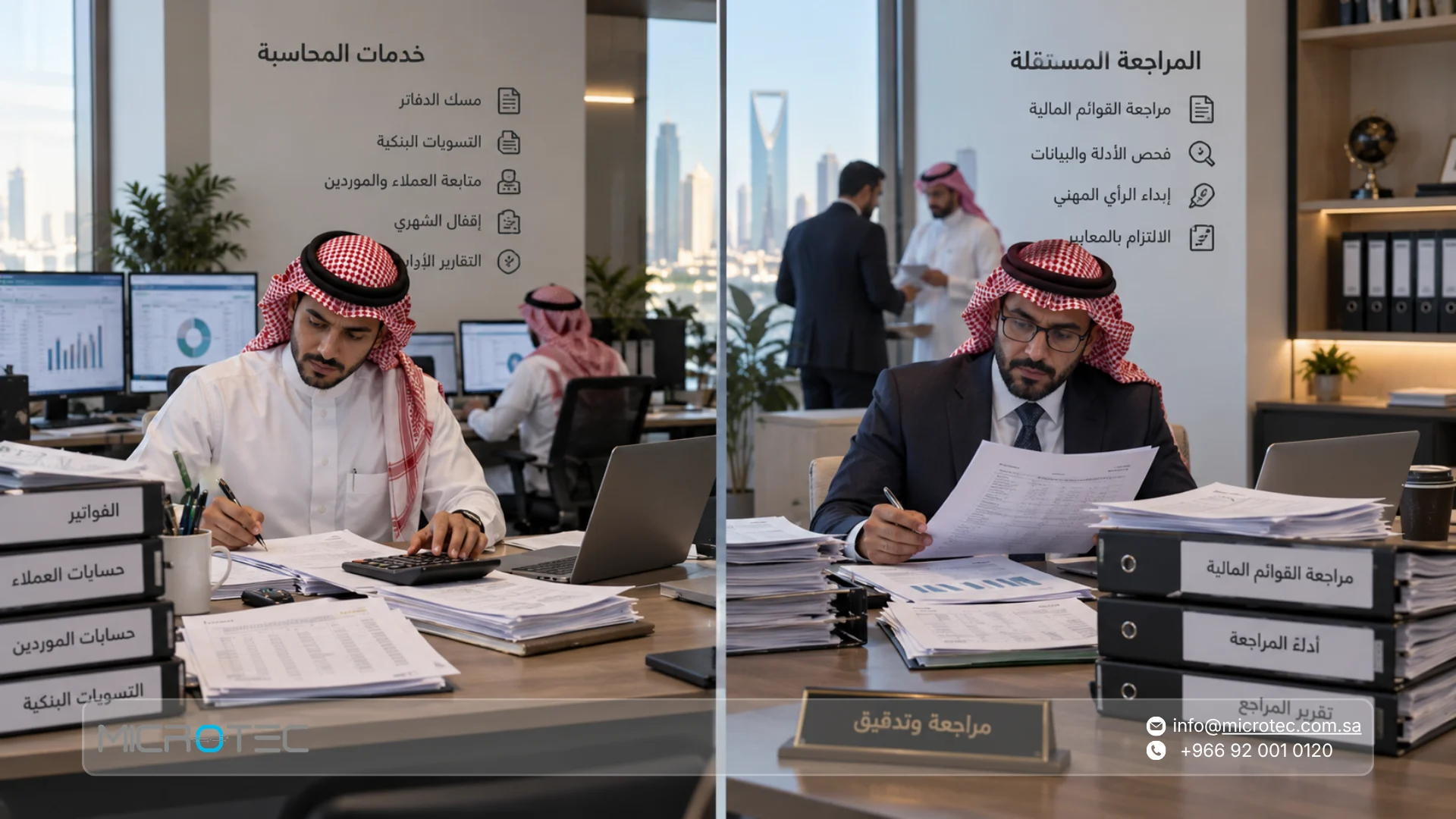
Can the Same Firm Prepare and Audit the Financial Statements?
This should be clarified before signing with a firm offering both accounting and audit services.
Auditor independence is fundamental to an audit engagement. SOCPA’s published professional inquiries confirm that the general rule requires an audit firm to remain independent and restricts the simultaneous provision of audit and other services to the same audit client, subject to specified exceptions.
That does not mean every additional service is automatically prohibited. It does mean the firm should assess the particular service against the applicable independence requirements.
Before combining services, ask:
- Who maintains the accounting records?
- Who prepares the financial statements?
- Who performs the audit?
- Does the additional service affect independence?
- Is another provider needed for part of the work?
- What report will be issued at the end?
Resolving this early avoids problems when the year-end audit is already under way.
Accounting Outsourcing and Remote Bookkeeping
Remote accounting can be practical when the company does not need a finance professional physically present every day.
A business may use outsourced accounting services for monthly bookkeeping, reconciliations, closing, and reporting while keeping management and approvals internally.
The effectiveness of remote accounting depends on the process around it. Before giving an external provider access, clarify who handles the account, who reviews the work, how documents are shared, what permissions are granted, and how quickly questions are answered.
Also confirm how your data will be returned if the engagement ends. The company’s accounting records should remain accessible to the company, not become dependent on one provider’s internal files.
If the wider problem is that your finance team or outsourced accountant works across disconnected tools, our guide to accounting software in Saudi Arabia explains when a standalone system is enough and when a connected ERP may be more appropriate.
How to Choose Among Accounting Firms in Saudi Arabia
Searching for the top accounting firms in Saudi Arabia can help you create a shortlist, but reputation alone does not determine whether a provider fits your business.
Sector experience matters. A retail company deals with stock, returns, and daily sales. A contractor works with projects and cost centers. A manufacturer needs stronger costing and inventory knowledge. A property company may deal with contracts, units, collections, and project expenses.
Before asking for proposals, give each provider the same basic information:
- required service;
- business activity;
- transaction volume;
- invoice count;
- number of bank accounts;
- branches;
- inventory requirements;
- employee count;
- current accounting system;
- condition of existing books;
- required reports;
- key deadlines.
This makes the proposals much easier to compare.
18 Things to Check Before Signing With an Accounting Firm
- Licence type: Confirm that the professional licence fits the work you need.
- Licence status: Check that it is currently valid rather than relying on an old certificate.
- Responsible professional: Know who will actually supervise your account.
- Sector experience: Look for experience relevant to your industry.
- Scope of work: The agreement should state what is included and excluded.
- Transaction limits: Check whether the fee includes a maximum number of entries, invoices, or bank transactions.
- Financial statements: Clarify who prepares them and whether audit is separate.
- Tax and Zakat: Specify exactly which services are included.
- Closing timetable: Agree on the deadline for each monthly close.
- Bank reconciliation: Define frequency and responsibility for unresolved items.
- Receivables and payables: Confirm whether aging and account reconciliation are included.
- Inventory: Make sure the provider understands your costing and stock process where relevant.
- Accounting system: Check whether the firm works in your system or transfers data elsewhere.
- User permissions: Control what external users can view, enter, edit, or approve.
- Document storage: Agree on how supporting records will be filed and retrieved.
- Communication: Identify the main contact and response expectations.
- Exit process: Define how all accounting data will be handed back.
- Additional fees: Ask which activities fall outside the monthly engagement.
These checks make it easier to compare two proposals that may look similar on price but differ significantly in actual service.
How to Verify a Firm’s Licence Before You Engage
Do not rely only on the word licensed in an advertisement or on a PDF certificate sent by the provider.
The Law of the Profession of Accounting and Auditing defines the professional licence and states that the regulated profession cannot be practised without it.
For accounting services, the Accounting Services Rules require a professional register containing information such as the practitioner’s name, licence number, licence dates, and the office or professional company through which the person practises.
SOCPA also provides a verification service through its professional services. When checking a provider, review:
- licence holder;
- licence number;
- licence type;
- current status;
- expiry date where applicable;
- professional firm or office;
- whether the licence covers your required service.
A degree, professional membership, or qualification is not by itself proof that someone holds every licence required to provide regulated professional services.
Why a List of Top Accounting Firms Is Not Enough
Online rankings and commercial directories can help with discovery, but they should not replace licence verification or due diligence.
A list may be outdated, and a well-known accounting company may still not be the right fit for your industry or service.
A better sequence is:
- Define the service.
- Verify the licence.
- Check sector experience.
- Compare scope.
- Compare delivery model.
- Compare fees.
This separates professional eligibility from commercial preference.
Balancing Fees Against Scope
When comparing accounting companies in Saudi Arabia, a lower monthly price does not necessarily mean a better deal.
One firm may quote only for bookkeeping, while another includes reconciliation, closing, customer and supplier follow-up, and monthly management reports.
Use the same scope for every quotation:
| Service | Included? | Frequency or limit |
| Transaction entry | Yes / No | Number of transactions |
| Bank reconciliation | Yes / No | Monthly |
| Month-end close | Yes / No | Monthly |
| Management reporting | Yes / No | Monthly / Quarterly |
| Customer balances | Yes / No | As agreed |
| Supplier balances | Yes / No | As agreed |
| Inventory support | Yes / No | Based on activity |
| Financial statement preparation | Yes / No | Periodic / Annual |
| Zakat or tax services | Yes / No | Define exact service |
| Audit | Yes / No | Separate engagement where required |
| Review meetings | Yes / No | Number included |
| Historical clean-up | Yes / No | Separate fee |
Once the scope is consistent, the fee comparison becomes much more meaningful.
Is a Low-Cost Accounting Firm a Risk?
Not automatically. A lower price may simply reflect a smaller team, more efficient delivery, fewer meetings, or a narrower scope. A higher price does not guarantee better service either.
The useful question is why the prices differ.
If two firms have the appropriate licensing and genuinely offer the same service level, selecting the less expensive proposal may be reasonable. The risk appears when a low price is achieved by removing services the business assumes are included.
Also Read: Field Force Management Software: Track Sales Reps in Real Time

How Better Accounting Systems Improve Outsourced Accounting
An external accountant can only work with the information the company provides.
If sales are in one spreadsheet, purchases in another, stock in a third system, and invoices arrive through email and messaging apps, a large part of the accountant’s time can be spent simply collecting and reconciling data.
A structured system does not replace the accountant. It gives the accountant better source data.
This matters especially in finance and accounting outsourcing, where every manual handoff between the company and its external provider creates another opportunity for delays and differences.
When sales, purchasing, inventory, customers, suppliers, and finance share connected data, the accounting provider can spend more time on review and less time reconstructing transactions.
Microtec: A Connected ERP Environment for Accounting Work
Microtec is not a replacement for an accountant, auditor, or adviser. The professional and the software perform different jobs.
The accountant applies accounting knowledge, review, and professional judgment. The system organizes the transactions and records on which that work depends.
Microtec’s current ERP environment connects finance with areas such as sales, purchasing, inventory, HR, and fixed assets. Its ERP modules also describe how purchasing, stock, customer activity, and finance can share information within connected workflows.
For a company using outsourced accounting, this can simplify the handover because more of the underlying records remain within one operational structure.
Microtec ERP vs Separate Files and Accounting Tools
| Area | Microtec ERP environment | Separate files and tools |
| Sales | Sales data can remain connected with customer and finance records | Accounting may receive a separate export |
| Purchasing | Purchasing, suppliers, receiving, and finance can share data | Documents may come from several sources |
| Inventory | Stock activity connects with operational transactions | Separate stock reconciliation may be needed |
| Customers | Customer transactions remain within the sales cycle | Balances may rely on external spreadsheets |
| Suppliers | Supplier data can connect with purchasing and finance | Manual matching may be required |
| Reporting | Reports use information recorded in the system | Data may need consolidation |
| Permissions | Access can be controlled within system configuration | Permissions differ across files and apps |
| Accountant handover | More records remain in one environment | Time is spent gathering multiple sources |
The value of integration is not that every company suddenly needs every ERP module. It is that the modules you do use can work from connected data.
How Connected Data Reduces Repetitive Accounting Work
It would be misleading to claim that a specific firm can serve a fixed percentage more clients simply by using Microtec without published evidence to support that result.
A more useful measure is the time spent on repetitive preparation.
If an accountant repeatedly asks for the same invoice, searches for the latest customer statement, imports sales files, or reconciles differences caused by separate systems, that time is spent before the accounting review even begins.
A connected system can reduce some of those steps by allowing purchases, sales, inventory movements, customer balances, supplier balances, and accounting records to originate from linked workflows.
Microtec’s ERP modules overview describes purchasing, receiving, supplier invoices, inventory updates, and finance as parts of connected processes rather than isolated records.
For an external accounting firm, cleaner data does not remove professional work. It removes some of the unnecessary work that happens before the professional work.
How Do You Know You Chose the Right Accounting Provider?
Do not wait until year-end to assess the relationship. Agree on practical service measures from the beginning and review them regularly. Check whether:
- the month closes on time;
- bank reconciliations are complete;
- unsupported transactions are followed up;
- customer balances are clear;
- supplier balances are current;
- unexplained differences are resolved;
- reports arrive on time;
- management can understand profitability and cash position;
- transactions can be traced to supporting documents;
- important issues are raised before deadlines.
Good accounting services should make the financial position clearer to management, not make the company dependent on its provider for basic information.
Choose the Service Before You Choose the Firm
Choosing among accounting firms in Saudi Arabia should begin with the work you need, not the most famous name or lowest monthly fee.
Define whether you need bookkeeping, financial statements, tax support, advisory work, or independent audit. Then verify the relevant licence and compare suitable providers by sector experience, scope, reporting, communication, systems, and total fees.
The accounting system matters too. When your accountant works from organized sales, purchasing, inventory, customer, supplier, and finance data, less time is lost rebuilding information from disconnected files.
If that is currently a problem in your business, try Microtec ERP with a real sales or purchasing transaction and follow its effect through to the accounting records and reports!
Frequently Asked Questions About Accounting Firms
1. What is the difference between an accountant and a CPA?
Accountant is a broad professional description. Depending on the role, an accountant may record transactions, reconcile accounts, prepare reports, analyze costs, or manage other finance activities.
CPA is a professional designation commonly associated with the United States and some other jurisdictions. In Saudi Arabia, the more important question for regulated work is whether the person or firm holds the Saudi professional licence required for the service.
For audit and other regulated professional engagements, verify the local licence rather than relying on a job title or foreign qualification alone.
2. How do I verify that an accounting firm is properly licensed?
Use the official SOCPA channels and check the provider’s professional details rather than relying only on its marketing material.
The Accounting Services Rules specify that the register contains details including the practitioner’s name, licence number, licence dates, and the office or professional company through which the service is provided.
Confirm that the licence is current and that its scope matches the work you intend to purchase.
3. How much do monthly accounting services cost for an SME?
There is no standard monthly fee for small business accounting services in Saudi Arabia.
Pricing can depend on transaction volume, invoices, bank accounts, branches, payroll, inventory, condition of the books, reporting requirements, and additional tax or year-end services.
The most useful comparison is to send the same scope of work to several providers and compare the prices for equivalent services.
4. Is outsourced accounting safe for confidential data?
It can be, provided the engagement has appropriate controls.
Before granting access, confirm who will work on the account, what each user can access, how documents are transferred, how credentials are managed, where records are stored, and how access will be removed at the end of the engagement.
Your accounting platform should also allow controlled permissions rather than giving external users unrestricted access.
5. Is an accounting office the same as an audit firm?
Not necessarily. Saudi Arabia regulates accounting services and the accounting and auditing profession. Different services can require different licences and, for audit work, additional independence considerations.
Always define the service first and then verify the provider’s licence.
6. Do I need an audit firm for monthly bookkeeping?
Usually not if the requirement is limited to bookkeeping, reconciliations, month-end closing, and routine financial reporting.
These activities may be performed internally or through an appropriately licensed accounting-services provider, depending on the engagement.
An appropriately licensed auditor is required when the work itself is an audit or another regulated assurance engagement.
7. Can a remote accounting company manage the books of a Saudi business?
Many accounting activities can be performed remotely if the provider is appropriately qualified and the company has a clear process for documents, access, review, and communication.
Before appointing a remote provider, confirm its licensing where required, the responsible accountant, reporting deadlines, user permissions, document storage, communication process, and how all records will be returned when the contract ends.
8. Can the same firm provide bookkeeping and audit services?
Potentially, but the combination must be assessed against the applicable independence rules.
SOCPA’s professional guidance emphasizes auditor independence and restricts combining audit and other services for the same audit client except in specified circumstances.
If you want one firm to provide both services, clarify the independence position before signing rather than assuming that the same provider can automatically perform both.