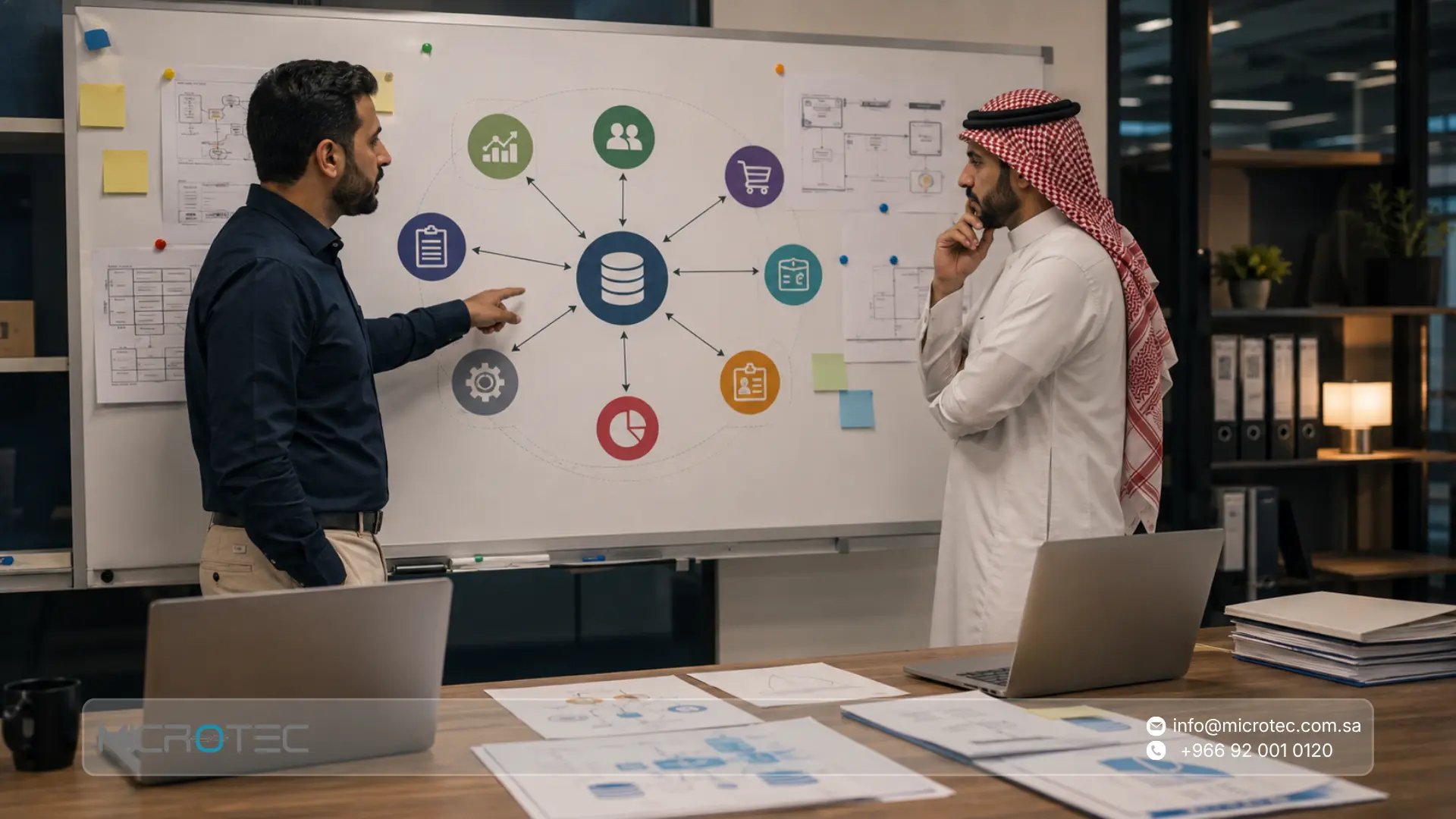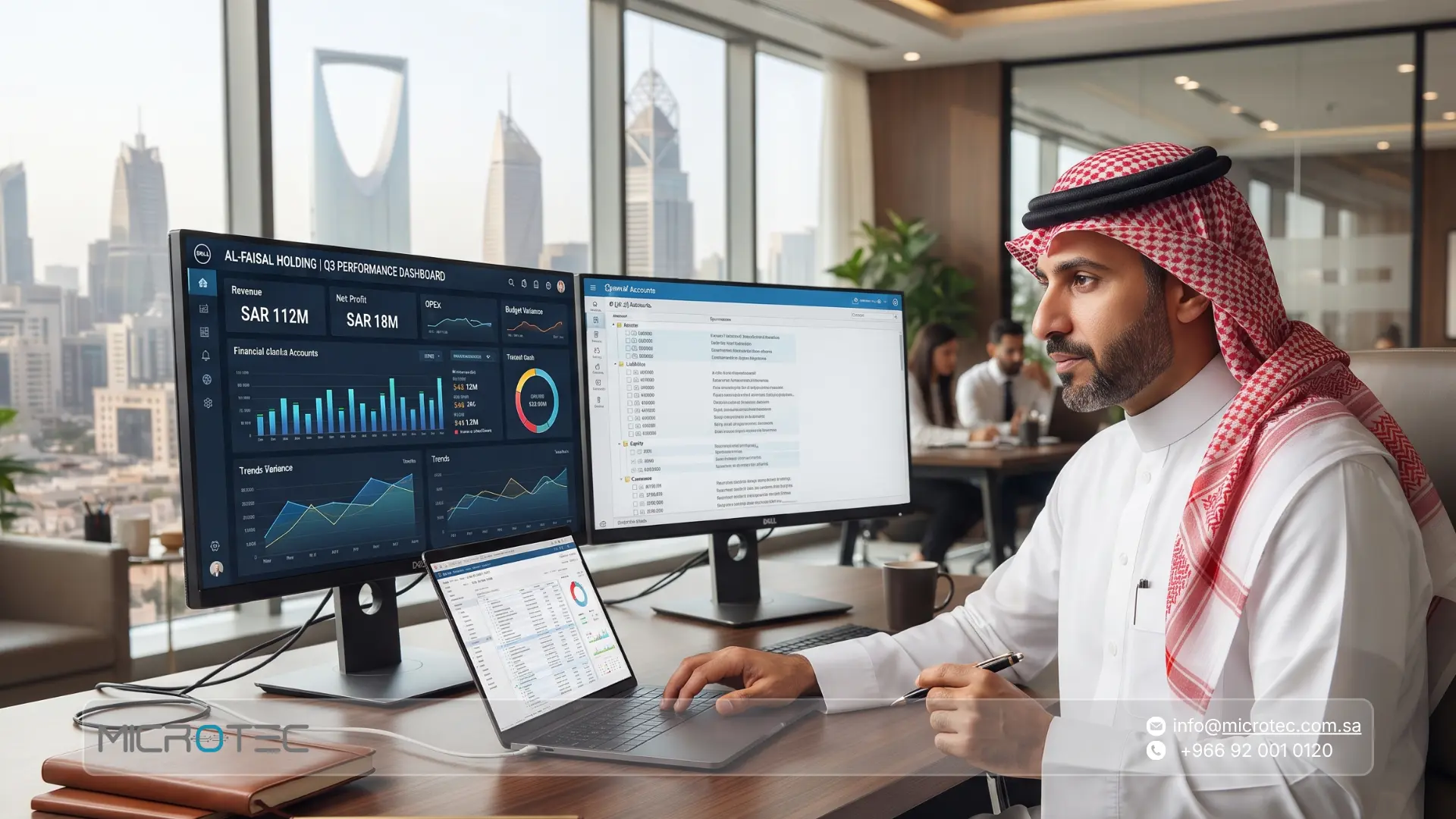
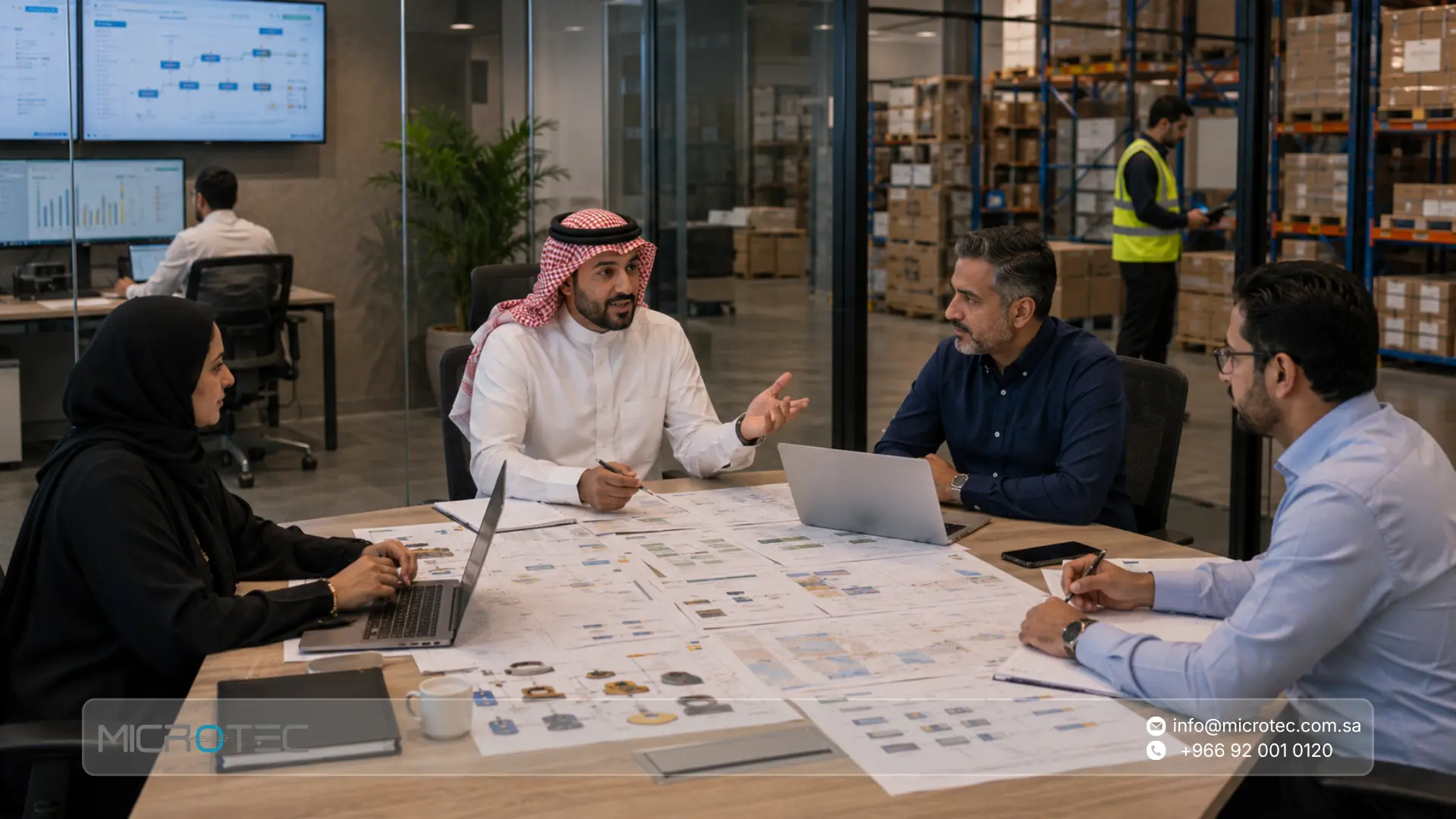
Choosing the best ERP software in Saudi Arabia is not about finding the system with the longest feature list or the most famous global brand. The right ERP system is the one that fits the way your company actually operates and connects sales, purchasing, inventory, finance, branches, warehouses, and other departments without forcing teams to depend on disconnected tools.
For Saudi businesses, ERP software selection also needs to account for local requirements. E-invoicing compliance, branch and warehouse management, Arabic usability, implementation support, and the ability to respond to regulatory or operational changes all matter when comparing ERP software companies in Saudi Arabia.
This guide explains how to choose an ERP system, what separates a suitable ERP system in Saudi Arabia from a generic solution, how to compare ERP software vendors, and why Microtec can be a strong fit for businesses looking for ERP software in Saudi Arabia.
What Makes an ERP System the Best Fit for Your Business?
There is no single best ERP system for every company. A manufacturing business, retailer, restaurant group, distributor, and professional services company may all need ERP software, but their operational requirements are very different.
The best ERP software is therefore the system that fits your business model, connects the processes that matter most, and can support the way your company operates today and as it grows.
Key Criteria for Choosing ERP Software in the Saudi Market
When evaluating ERP software in Saudi Arabia, focus on the areas that directly affect daily operations.
- Process fit: The system should support the way sales, purchasing, inventory, finance, and approvals actually work inside the company.
- Integration: Related departments should work with connected data instead of maintaining separate records.
- E-invoicing readiness: The ERP software should support the invoicing requirements that apply to businesses in Saudi Arabia.
- Branch and warehouse management: Companies with several locations need centralized visibility over stock, sales, transfers, and performance.
- Permissions and approvals: The system should reflect internal responsibilities and approval levels.
- Reporting: Management should be able to access the operational and financial reports it actually uses.
- Scalability: The ERP system should accommodate new users, warehouses, branches, and business units when required.
- Implementation quality: Data migration, testing, training, and configuration are as important as software features.
- Support: Local or accessible technical support becomes critical once ERP is part of daily operations.
A strong ERP software provider should be able to explain how each of these areas will work in your actual environment, not simply show a generic demo.
Why the Right ERP System Changes With Company Size and Industry
The right ERP system changes according to business complexity. A small retailer may primarily need POS, stock, purchasing, and accounting integration.
A multi-branch distributor may need:
- Customer orders.
- Mobile or field sales.
- Vehicle inventory.
- Several warehouses.
- Returns.
- Collections.
- Central accounting.
- Branch reporting.
A manufacturing company may place greater emphasis on production, materials, costing, and procurement. A project-based business may care more about project costs, budgets, billing, resources, and profitability by project.
This is why the question “what is the best ERP system?” cannot be answered by naming one product without first understanding the company.
What Sets Saudi-Ready ERP Software Apart From Generic Global Systems?
Global ERP platforms can be powerful, but companies operating in Saudi Arabia need to assess more than product reputation.
A Saudi-ready enterprise resource planning solution should fit the company’s local operating and regulatory environment.
1-E-Invoicing and ZATCA Compliance Support in ERP Software
E-invoicing is one of the most important considerations when evaluating ERP software in Saudi Arabia.
Saudi Arabia’s e-invoicing program operates under the requirements of the Zakat, Tax and Customs Authority. The second phase, known as the Integration Phase, has been introduced in waves and requires affected taxpayers to integrate their e-invoicing solutions with the Fatoora platform according to the applicable technical requirements.
By 2026, ZATCA was still expanding Phase Two to additional taxpayer groups. This makes e-invoicing support an operational requirement rather than an optional ERP feature.
When evaluating ERP software solutions in Saudi Arabia, companies should verify:
- Whether invoices can be generated according to applicable requirements.
- Whether the system supports the required tax information.
- How integration requirements are handled.
- Whether invoice data remains connected to sales and accounting.
- How the ERP provider handles future regulatory changes.
- Whether technical support is available during implementation and integration.
Compliance should also be described accurately. A software provider should not rely only on broad claims such as “approved ERP.” The important question is whether the implemented solution complies with the requirements applicable to the business and supports the required integration.
2-Arabic Language Support and Local Usability
Arabic language support matters because ERP is not used only by management or finance.
Employees in purchasing, warehouses, sales, HR, and branches may interact with the system every day.
When comparing ERP software Saudi Arabia options, check:
- Arabic interface availability.
- Arabic invoice and document output.
- Arabic customer and supplier data.
- Bilingual reporting where needed.
- Ease of use for local teams.
- Support for local business terminology.
Do not assume that a globally available ERP automatically provides a practical Arabic experience for every department.
Hijri calendar support should also be verified directly with the ERP software vendor if it is an operational requirement for your company, rather than assumed from general Arabic-language support.
3-Local Support for Companies in Riyadh and Across Saudi Arabia
ERP becomes part of core business operations, so support quality matters after implementation as much as during the sales process.
For companies looking for ERP software in Riyadh or business management software in Riyadh, local availability can be especially useful when implementation, training, troubleshooting, or process review requires direct coordination.
Microtec currently lists locations in Riyadh, Al Khobar, and Jeddah and provides technical support for its solutions.
For companies comparing ERP software companies in Saudi Arabia, support should be evaluated based on:
- Response process.
- Technical expertise.
- Availability after go-live.
- Understanding of the implemented configuration.
- Ability to support users and administrators.
- Handling of regulatory or operational changes.
- Maintenance and update processes.
A lower software price can quickly lose its advantage if critical issues take too long to resolve.

Practical Steps to Choose the Best ERP Software
ERP software selection should start with your business, not with a list of software vendors. A structured selection process reduces the risk of buying a powerful system that does not solve your actual problems.
1. Document Your Current Processes
Start by identifying the processes that need to be managed or connected. These may include:
- Sales.
- Customer invoicing.
- Purchasing.
- Suppliers.
- Warehouses.
- Inventory transfers.
- Stock counting.
- Collections.
- Payments.
- Cost centers.
- HR.
- Fixed assets.
- POS.
- Field sales.
This gives you a practical baseline for ERP software comparison.
2. Identify the Current Problems
Define what the new ERP system needs to solve. Typical issues include:
- Duplicate data entry.
- Stock discrepancies.
- Delayed reports.
- Difficulty tracking branches.
- Weak approval controls.
- Purchasing outside the system.
- Sales data disconnected from accounting.
- Excessive dependence on Excel.
- Limited profitability analysis.
If these problems are not defined before ERP software selection, the company may choose a system that looks impressive but does not solve its most important operational issues.
3. Define the Essential Requirements
Separate must-have requirements from optional features. Consider:
- Number of users.
- Branches.
- Warehouses.
- Approval levels.
- Required reports.
- Integration needs.
- Transaction volumes.
- Industry-specific processes.
This helps keep ERP software comparison focused.
4. Compare ERP Software Companies
Do not compare ERP software companies in Saudi Arabia only by price. Evaluate:
- Experience in your industry.
- Understanding of Saudi business requirements.
- ERP functionality.
- Integration between modules.
- E-invoicing support.
- Data migration.
- Training.
- Technical support.
- Required customization.
- Scalability.
- Implementation methodology.
The right ERP software company should understand the business process before configuring the system.
5. Test Real Business Scenarios
A generic product demo is not enough. Ask ERP software vendors to demonstrate real scenarios from your company, such as:
- A purchase order with partial receiving.
- A sale and return.
- A warehouse transfer.
- Customer collection.
- Supplier invoice review.
- Branch stock reporting.
- Cost-center reporting.
Testing actual workflows makes it easier to compare competitors for ERP software objectively.
6. Review the Implementation Plan
The ERP system company should explain how it will handle:
- Process review.
- Data preparation.
- Migration.
- Configuration.
- Permissions.
- Testing.
- Training.
- Go-live.
- Post-launch support.
How the software is implemented can matter as much as the product itself.
18 Criteria to Check Before Signing With an ERP System Company
Before choosing an ERP software provider, review these 18 areas.
- Fit with your business processes: The system should support actual operations rather than forcing unnecessary workarounds.
- Sales management: Orders, customers, pricing, invoicing, returns, and collections should fit the sales cycle.
- Purchasing: Purchase requirements, approvals, purchase orders, receiving, and suppliers should be manageable in one process.
- Inventory: Warehouses, transfers, adjustments, counting, and stock visibility should match operational requirements.
- Finance: Operational transactions should connect properly with accounting.
- Cost centers: Management should be able to analyze financial results at the level required by the business.
- Branch management: Multiple locations should be manageable without creating separate disconnected systems.
- User permissions: Roles should reflect who can create, approve, edit, and review transactions.
- E-invoicing: The system should support applicable Saudi e-invoicing requirements.
- Reporting: Reports should match the decisions management needs to make.
- Integrations: Check compatibility with POS, field sales, industry-specific systems, or other required applications.
- Data migration: Existing customers, suppliers, products, balances, and records should be migrated carefully.
- Scalability: The ERP should support future users, branches, warehouses, and business growth.
- Customization: Necessary modifications should be clearly separated from standard functionality.
- Testing: Real workflows should be tested before full rollout.
- Training: Each user group should receive training relevant to its responsibilities.
- Technical support: Support should continue after implementation.
- Total cost: Compare licensing, implementation, customization, migration, training, support, and integrations together.
These criteria provide a more useful framework than simply searching for a top 10 ERP software list and selecting the best-known name.

ERP Software Comparison: What Should You Actually Compare?
A useful ERP software comparison should focus on fit, not just product features.
Criterion | Why It Matters |
Business process fit | Determines whether employees can use the ERP without excessive workarounds |
Industry fit | Different industries have different workflows |
Saudi compliance | Important for invoicing and local operations |
Financial integration | Connects operational activity with accounting |
Inventory capabilities | Essential for product-based businesses |
Multi-branch support | Important for growing companies |
Reporting | Determines management visibility |
Integrations | Reduces disconnected applications |
Implementation | Affects adoption and project risk |
Training | Improves user acceptance |
Support | Critical once ERP becomes operational |
Total cost | Gives a more accurate view than license price alone |
Companies searching for the best ERP software often focus heavily on features, while process fit and implementation quality can be more important to the final result.
Should You Choose Cloud ERP or an On-Premise ERP System?
ERP systems can use different deployment models.
Cloud ERP is hosted and delivered by the vendor or infrastructure provider, while an on-premise or locally deployed ERP environment is installed within infrastructure controlled by the organization or its implementation environment.
The decision may depend on:
- Internal IT policies.
- Infrastructure requirements.
- Security policies.
- Connectivity.
- Backup approach.
- Performance needs.
- Integration requirements.
- Cost model.
- Internal technical resources.
Microtec should not be described as a cloud ERP provider. We focus on configuring and implementing our ERP solutions according to the customer’s operating environment and applicable infrastructure.
The right question is therefore not simply whether cloud ERP is better than on-premise ERP, but which architecture fits the company’s actual operating and technical requirements.
ERP Software in Riyadh: What Should Local Companies Consider?
Companies searching specifically for ERP software in Riyadh or the best ERP software in Riyadh should use the same selection criteria as businesses elsewhere in Saudi Arabia, but local support can become particularly important.
Businesses in Riyadh may need ERP for:
- Corporate headquarters.
- Multiple branches.
- Distribution centers.
- Retail operations.
- Service companies.
- Large sales teams.
- Centralized finance.
- Procurement operations.
When comparing ERP software Riyadh providers, check whether the provider can support both the technical system and the operational implementation.
The best ERP software solution provider in Riyadh is therefore not necessarily the company with the largest product catalog. It is the provider that can understand the business processes, configure the required functions, support users, and maintain the environment after go-live.

Microtec: ERP Software for Businesses in Saudi Arabia
At Microtec, we do not begin by trying to sell the largest possible number of modules. We start by understanding how the company operates and where its processes need to connect.
One business may need to solve inventory discrepancies. Another may need to organize purchasing across several branches. A distribution company may need to connect field sales with vehicle stock and central accounting.
That is why we do not apply exactly the same ERP configuration to every customer.
Microtec ERP is designed to connect core business areas such as sales, purchasing, inventory, finance, HR, and fixed assets, with specialized operational solutions available for retail, restaurants, and field sales.
Sales Connected With Inventory and Accounting
A sale affects more than an invoice. In an integrated ERP environment, the sales process can connect:
- Customer information.
- Orders.
- Invoices.
- Inventory movement.
- Accounting impact.
- Reporting.
The objective is for departments to work from the same transaction rather than record different versions of it.
Purchasing Connected With Suppliers, Inventory, and Finance
Purchasing begins before the supplier invoice reaches accounting. With Microtec ERP, the purchasing environment can bring together:
- Purchase requirements.
- Purchase orders.
- Suppliers.
- Receiving.
- Inventory.
- Supplier invoices.
- Financial impact.
This allows management to follow purchasing earlier in the process rather than seeing it only after the cost reaches finance.
Inventory Connected With Daily Operations
Inventory should not operate as a separate list of quantities. Within ERP, inventory movements are connected to operational events such as purchasing, receiving, selling, returns, transfers, and stock counts.
This helps management understand not only how much inventory exists, but also why stock changed.
Financial Management Connected to the Source Transaction
A useful ERP system does not show financial figures without operational context.
Sales create revenue and receivables. Purchasing creates liabilities. Inventory carries cost. Cost centers can help management analyze results in more detail depending on the configured structure.
Connecting finance to source transactions provides management with more context than isolated accounting totals.
Microtec Systems That Extend ERP by Business Type
Different companies need different operational environments.
- O-GREEN: For retail and point-of-sale operations.
- O-RED: For restaurants and cafés.
- O-Orange: For field sales and distribution teams.
- Microtec ERP: For centralized management of finance, purchasing, inventory, sales, HR, assets, and other core functions.
The purpose is not to make every company use every product. The appropriate combination depends on its operating model.
Microtec vs. Global ERP Software
Global ERP systems can provide extensive functionality, while Microtec focuses on a different selection priority: practical fit for the customer’s operating environment in Saudi Arabia.
Area | Large Global ERP Platforms | Microtec |
Functional breadth | Often very extensive | Focused on required business processes |
Implementation complexity | Can be high depending on product and scope | Configured around the agreed business scope |
Saudi business context | Depends on vendor and local partner | Built around customers operating in Saudi Arabia |
E-invoicing requirements | Must be evaluated for local configuration | Considered within Saudi implementation requirements |
Arabic usage | Varies by platform and implementation | Relevant to local user environments |
Retail | Often through modules or partner products | O-GREEN |
Restaurants | Often requires industry-specific modules | O-RED |
Field sales | May require additional applications | O-Orange |
Local support | Depends on local partner | Microtec provides support locally |
Riyadh presence | Depends on vendor | Microtec has a Riyadh presence |
Other Saudi regions | Depends on implementation partner | Microtec also lists Al Khobar and Jeddah locations |
The comparison is not intended to claim that a local solution is always better than a global ERP system. Large international platforms may be suitable for highly complex multinational environments.
The key is selecting the system whose capabilities, implementation model, support structure, and cost match your company.
How We Start ERP Implementation at Microtec
We begin by understanding operations before moving data.
- Business-process review: We review sales, purchasing, inventory, finance, branches, and users.
- Scope definition: We determine which ERP functions and operational solutions are required.
- Data preparation: Customer, supplier, product, account, inventory, branch, and warehouse data is reviewed.
- Permissions: User responsibilities and approval levels are defined.
- Testing: Real scenarios such as purchasing, receiving, sales, returns, and stock transfers are tested.
- Training: Each team is trained on the functions relevant to its work.
- Go-live and support: The system is reviewed during real operation and support continues after launch.
This approach helps keep ERP implementation tied to how the business actually operates rather than treating implementation as a technical installation only.
If you are comparing ERP software companies in Saudi Arabia, contact Microtec to review a real workflow from your company and evaluate the required ERP scope before implementation.
How to Compare Microtec With Other ERP Software Vendors
Before choosing Microtec or another ERP software company, compare each provider using the same scenarios.
Ask each vendor to show how the system handles:
- Customer order to invoice.
- Purchase request to receiving.
- Warehouse transfers.
- Returns.
- Collections.
- Supplier liabilities.
- Branch reporting.
- Cost centers.
- Permissions.
- Required Saudi invoicing processes.
This creates a fair ERP software comparison and reduces the influence of presentation style or marketing claims.
ERP Software Provider vs. ERP Software Development Company
These terms are sometimes used interchangeably, but they can describe different roles.
- An ERP software provider supplies and implements an ERP product.
- An ERP software development company may build software itself, customize platforms, or develop industry-specific ERP applications.
- An ERP system company may combine software provision, implementation, customization, training, and support.
- An enterprise resource planning solution company may focus on designing and implementing the broader ERP environment.
When evaluating enterprise resource planning software companies, ask what the company actually provides rather than relying on the title it uses.
Finally, Choosing the best ERP software in Saudi Arabia requires more than comparing features or searching for the most popular ERP brand.
The right ERP system should fit the company’s actual operating model, connect departments that depend on each other, support Saudi business requirements, provide useful reporting, and offer a realistic implementation and support plan.
For businesses comparing ERP software in Saudi Arabia, the most important questions are practical:
- Does the system match our processes?
- Can it connect sales, purchasing, inventory, and finance?
- Does it support our branches and warehouses?
- Can it support applicable e-invoicing requirements?
- Can our users work with it effectively?
- Can the provider implement and support it properly?
At Microtec, we start from these operational questions and configure the ERP environment around the needs of the business. We also provide specialized solutions including O-GREEN for retail, O-RED for restaurants and cafés, and O-Orange for field sales and distribution.
If you are evaluating ERP software companies in Saudi Arabia, contact Microtec to review your current business process and determine the ERP configuration that fits your operations.
Frequently Asked Questions About ERP Software in Saudi Arabia
1-What Is the Best ERP Software in Saudi Arabia?
The best ERP software is the one that fits your business processes, industry, reporting needs, branches, and integrations. Microtec ERP is designed for companies that need to connect sales, purchasing, inventory, finance, HR, and assets within one system.
2-How Do I Choose the Right ERP System?
Focus on process fit, required modules, reporting, integrations, e-invoicing support, scalability, implementation, and technical support. The system should solve your actual operational problems, not simply offer more features.
3-Is There ERP Software in Saudi Arabia That Supports E-Invoicing?
Yes. ERP systems can support Saudi e-invoicing requirements. At Microtec, we consider applicable ZATCA requirements as part of ERP implementation for businesses in Saudi Arabia.
4-What Is the Difference Between ERP for Large and Mid-Size Companies?
Large companies usually need more users, branches, permissions, integrations, and complex reporting. Mid-size companies often need the same core ERP functions with a smaller implementation scope.
5-How Long Does ERP Implementation Take?
It depends on the number of modules, branches, data quality, integrations, customization, testing, and training. At Microtec, the implementation scope is defined according to the company’s actual requirements.
6-How Much Does ERP Software Cost in Saudi Arabia?
ERP cost depends on users, modules, branches, implementation, data migration, integrations, customization, training, and support. It is better to compare the total project value rather than the license price alone.