
When it comes to financial and business management in medium and large enterprises in Saudi Arabia, relying on paper ledgers or non-integrated traditional software exposes management to data chaos and delayed financial closing.
The chart of accounts (COA) represents the infrastructure and financial compass through which all economic and operational events transform into clear figures and statements that help decision-makers allocate resources efficiently.
In this guide, we clarify the strategic importance of the chart of accounts, how to build a COA compatible with IFRS standards and the Zakat, Tax and Customs Authority (ZATCA), while reviewing practical methods to automate entries and avoid errors through our solutions at Microtec.
Disclosure: Features, availability, prices, implementation durations, integrations, hardware, and policies may vary depending on the system and the facility’s needs; there is no general guarantee, and the best decision relies on practical evaluation and documented data.
What is the Chart of Accounts and Why is it the Backbone of Financial Management?
The chart of accounts is defined as the organized and flexible structure that includes all financial accounts of companies, arranged and numbered in a logical manner that reflects the nature of commercial operations. The role of the chart of accounts is not limited to being merely a tool for recording entries, but it is the common language linking operational departments with financial management.
Its utmost importance appears in:
- Fast Financial Closing: Enabling the issuance of financial statements (income statement, statement of financial position, cash flows) accurately and without delay.
- Internal Control: Providing transparent visibility into revenue sources and expense directions, preventing financial waste.
- Regulatory Compliance: Facilitating internal and external auditing and submitting official reports to relevant authorities.
Read more: Best POS System for Restaurant in Saudi Arabia: Comparison and Selection Criteria
Hierarchical Structure and Digital Coding Mechanism in the Chart of Accounts
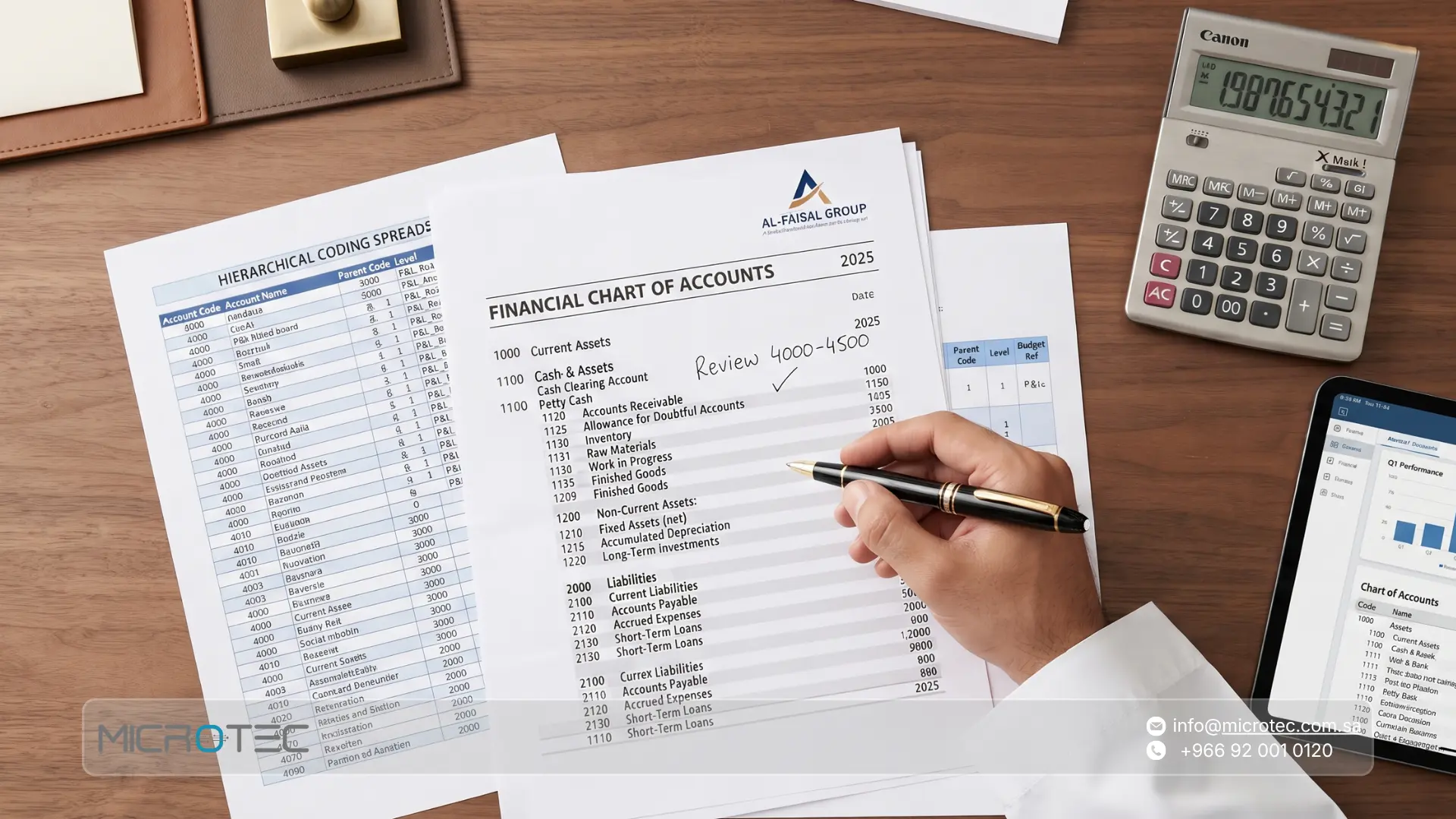
The financial structure relies on dividing accounts into graded levels starting from general classifications down to analytical sub-accounts. This is done via a digital coding system that grants each account a unique number indicating its nature.
The five main accounts are distributed according to the recognized structure as follows:
| Main Classification | Identification Code (Example) | Components and Operational Examples |
|---|---|---|
| Assets | Starts with 1 | Cash in safe, banks, accounts receivable, inventory, fixed assets |
| Liabilities | Starts with 2 | Suppliers, notes payable, short and long-term loans, provisions |
| Equity | Starts with 3 | Capital, retained earnings, statutory reserves |
| Revenues | Starts with 4 | Sales revenue, service revenue, other revenues |
| Expenses | Starts with 5 | Cost of goods sold, salaries and wages, rents, general expenses |
Every main section (first level) branches into sub-levels (second and third levels) to ensure detailed breakdown for each financial item.
Also Read: What is Meant by POS in a Bank Statement? A Merchant’s Guide
The Impact of International Financial Reporting Standards (IFRS) and Financial Transformation in Saudi Arabia (SOCPA)
The financial and accounting sector in Saudi Arabia witnessed radical transformations with the adoption of International Financial Reporting Standards (IFRS) supervised by the Saudi Organization for Chartered and Professional Accountants (SOCPA).
This transformation forced a re-engineering of the chart of accounts to comply with modern concepts:
- Revenue Standard (IFRS 15): Led to the creation of accounts related to performance obligations and deferred contract revenues instead of immediate revenue recognition before service or goods delivery.
- Leases Standard (IFRS 16): Required adding specific accounts for “Right-of-Use Assets” and obligations associated with long-term lease contracts under non-current assets and liabilities.
- Asset Depreciation (IAS 16) and Impairment (IAS 36): Mandated allocating independent accounts for accumulated depreciation and impairment provisions to accurately reflect fair book value.
Here is a quick comparison showing the difference between traditional structure and modern standard-compliant structures:
| Comparison Criteria | Traditional Chart of Accounts | IFRS-Compliant Chart of Accounts |
|---|---|---|
| Flexibility and Depth | Static and focuses only on simple bookkeeping. | Dynamic and designed to reflect fair value and financial performance. |
| Revenue Recognition | Occurs upon invoice issuance regardless of obligation. | Aligns with fulfilling conditions of transferring control (per IFRS 15). |
| Asset Processing | Fixed depreciation entries without periodic impairment tests. | Clear link between assets, right-of-use, and impairment tests. |
Note: It is always recommended to consult a certified public accountant to ensure proper application of these standards according to your enterprise’s size and nature.
How Does the Design of a Specialized Chart of Accounts Vary by Industry Sector?
There is no single unified copy identical for all companies; design closely depends on the operational cycle of each sector:
- Contracting Sector: Requires a chart supporting direct and indirect project costs, “Work in Progress” (WIP) accounts, letters of guarantee and retention accounts, plus tracking subcontractors.
- Real Estate Development Sector: Focuses on customer advance payment accounts and distributing capital costs for each real estate project individually to accurately evaluate profitability via independent analytical accounts.
- Non-Profit Sector: Requires special structuring matching guidelines of charitable societies to divide funds (restricted, unrestricted, and endowments) to ensure transparency before donors and supervisory authorities.
Are you suffering from manual account chaos? Discover how the Microtec ERP system organizes your chart of accounts automatically. Request a free consultation.

Preparing the Chart of Accounts for Integration with E-Invoicing (ZATCA)
With the completion of e-invoicing phases (ZATCA) in the Kingdom, enterprises are mandated to link their accounting systems directly with the “Fatoora” platform. This compatibility requires precise preparation of tax accounts within the chart of accounts.
Tax Accounts Preparation Checklist:
- [ ] Open an independent account for “Output VAT” under liabilities (for collected sales).
- [ ] Open an independent account for “Input VAT” under current assets (for purchases and expenses).
- [ ] Ensure linking every item in the chart of accounts with the correct tax rate (standard, zero-rated, or exempt).
- [ ] Verify technical system readiness for API integration with the authority’s requirements to ensure zero discrepancies between books and issued invoices.
Governance of the Chart of Accounts Through Internal Control Engineering to Prevent Manipulation
Opening modification privileges or adding random accounts to any employee represents a loophole threatening the safety of financial position. Governance of the chart of accounts requires:
- Delegation of Authority Matrix: Limiting privileges to modify, merge, or deactivate accounts strictly to the Chief Financial Officer (CFO) or senior management.
- Preventing Actual Deletion: Relying on the “Deactivate” feature for accounts no longer in use to prevent deleting historical financial data that underwent previous movements.
- Periodic Review: Conducting regular reconciliations by internal auditors to ensure no fictitious accounts or misclassified expenses exist.

How Microtec Systems Transform the Chart of Accounts from Manual Entries to a Smart System
Modern complex systems have exceeded companies’ need for exhausting manual entries; our solutions at Microtec provide smart integration linking all enterprise departments to a unified, live-updated chart of accounts:
- ERP Accounting System: Links sales, purchases, and inventory to general accounts automatically, utilizing “Analytic Accounts” to distribute costs and revenues without inflating the main tree structure.
- O-RED Restaurant System: Deducts raw materials from inventory and directs their value to the cost of goods sold in the income statement immediately upon completion of each customer order.
- O-GREEN Retail System: Executes double-entry bookkeeping for sales and updates inventory instantly and synchronously with every retail transaction.
- O-Orange Field Sales System: Ensures field representatives’ invoices and collections reflect in the company’s financial system the moment they are issued.
Manage your restaurant or store accounts accurately: try O-RED, O-GREEN, or explore the ERP Accounting System now.
In conclusion, the chart of accounts represents the bedrock upon which all financial reports and statements are built. Designing a flexible chart compatible with international standards and ZATCA requirements, and most importantly automating it via trusted systems like Microtec solutions, rids your company of manual errors and grants you clear financial vision to support decision-making in a timely manner.
Transition today to integrated cloud accounting with the ERP Enterprise Resource Planning system, and do not hesitate to contact Microtec experts to evaluate your enterprise’s needs.

Frequently Asked Questions About the Chart of Accounts in Saudi Arabia
1- Is the chart of accounts unified for all companies in Saudi Arabia?
No, the general framework of the five accounts (assets, liabilities, equity, revenues, expenses) is unified and stable, but precise sub-divisions and lower levels differ radically based on the nature and size of the enterprise’s activity (commercial, industrial, contracting, service) and financial management needs.
2- Can I modify or delete an account from the chart of accounts after using it?
It is legally and technically prohibited to delete any account that has undergone previous financial movements to preserve historical bookkeeping integrity. Instead, modern systems like Microtec systems offer a “Deactivate” feature for accounts to prevent future use.
3- What is the difference between main accounts and analytical accounts in an ERP system?
Main accounts form the fixed structure displayed in closing financial statements, while “Analytic Accounts” are used to track and distribute revenues or expenses to specific projects, branches, or cost centers without needing to bloat the main chart of accounts tree.
4- Is designing the chart of accounts the programmer’s responsibility or the accountant’s?
Designing the structure, determining coding levels, and classification policies are core responsibilities of the financial manager or certified public accountant based on accounting standards, while the ERP implementation consultant (like the Microtec team) translates and engineers this structure inside the tech system to link its units effectively.